Sunday, February 16, 2014

The secret story of the Venus of Willendorf.


Microscopic investigations on the world famous statuette from the Gravettian period (30,000 to 22,000 years ago) carried out at the Natural History Museum in Vienna revealed three incredible insights, and when taken together tell a secret story of this Palaeolithic figurine and her creators.
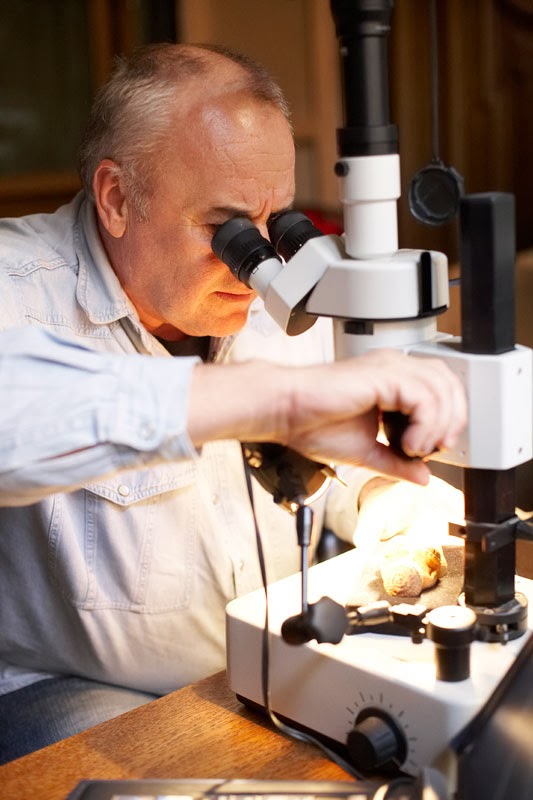
  • The limestone from which the 11cm high Venus had been carved, comes almost certainly from the region around the Moravian city of Brno 136km to the northeast of Willendorf.
  • The source of the flint blades discovered with the figure was North Moravia, a further 150km to the north.
  • The Venus had once been completely painted with red ochre, and given the ritualistic associations of this material meant that the figure was more than likely a cultic object.

The limestone of Stránská Skala in Brno

After an extensive programme of comparison of a large dataset of various limestone types, the proverbial needle was located in the haystack. The limestone rock from which the Venus of Willendorf could have been made​​, came from an unexpected location. The limestone is often called 0olite, and is composed of millimetre-sized calcoliths (skeletons of tiny sea creatures). Only on the Stránská Skala, a limestone massif in the city area of Brno (Brünn), can an identical rock type be found. This places the origin of the stone for the Venus at this precise location.

Nordic flint from the moraines region of Moravia

Analysis of the flint tools from the Ice Age camp of Willendorf, along with a detailed lithic provenancing examination showed that up to one third of the blades that are typical of the Gravettian culture were made from what is known as northern flint. This raw material was never available on the Danube, but must have been brought from the northern moraines region to Willendorf. The long narrow blades from this high-quality flint are exceptional, however, it is what is not present that opens up a window onto its origins and the movement of the people themselves. The Willendorf site contains no suitable cores to makes these blades, which can only suggest that they were already complete when they arrived at the Danube and the cores were left at the site of extraction and production far to the north.
These findings appear to represent evidence of long range seasonal migrations of the Ice Age Gravettian people moving from summer and winter camps between 30,000 - 27,000 years ago. The group would have spent the warmer seasons in the cool highlands, while in winter they would settle in the area of the Danube valley. This route would take them through the area where they could gather the material to carve the limestone figurine, and  collect the flint nodules in the moraine deposits of the Nordic Ice sheets from the northern flint glacial region of Moravia where they would make the tools, before carrying them all the way to the Danube during the harsher winder months.

Red painted figure
There is a great deal of evidence showing the entire surface was once painted with red ochre and analysis shows that the entire figure was originally painted red. The Venus of Willendorf was recorded to have been covered with a thick layer of red ochre when she was found in 1908, however, it seems that overzealous cleaning removed most of this covering. The small female figure was most likely cultic or religious in function, carried by the band of Gravettian and it is acknowledged that red ochre is often represented as a sacred colour and used in burial rites.  Many figurines were hidden in dwellings with some buried in small pits. It seems plausible that the nomadic Stone Age hunters carried these small and therefore portable  ‘idols’ with them as they moved from camp to camp.


Source: PH

900-Year-Old Viking Message Decoded, Reads 'Kiss Me'


The mystery of a 900-year-old Viking message has finally been solved. Cryptologists, put down your cipher devices, because the formerly incomprehensible code that's been haunting your dreams reads in part: "Kiss me."

The baffling Jötunvillur code, which dates back to as early as the 9th century, has popped up in over 80 different Norse inscriptions, puzzling runologists (those who study the Viking rune alphabets) for some time. That is, until Jonas Nordby, a runologist from the University of Oslo, valiantly broke the code, realizing a simple pattern amongst the writings.
"For the jötunvillur code, one would replace the original runic character with the last sound of the rune name," he explained in an interview with Forskning.no. "For example, the rune for 'f', pronounced 'fe,' would be turned into an 'e,' while the rune for 'k,' pronounced 'kaun,' became 'n.'"

Sounds easy, right? Nordby sifted through all the findings of rune codes in northern Europe, mainly Scandinavia and the British Isles, to settle on his conclusion. Cryptologists previously thought the code was used to communicate secret messages, but Nordby thinks the pattern might have been instrumental in the teaching of rune instead. For instance, a means of memorizing the order of the alphabets.
"We have little reason to believe that rune codes should hide sensitive messages," Nordby claims. "People often wrote short everyday messages."
Amongst them -- "Kiss me," shown in coded rune in the first image above. Perhaps Nordby has stumbled upon a nearly millennium-old love letter? Dare we say, a Valentine? Whatever the case, runic code researchers deserve a round of applause. There's nothing like the glee felt after solving a good ol' medieval mystery.

Source: HP

Saturday, February 15, 2014

Filmmakers search for Montezuma's treasure in Kanab pond


KANAB, Kane County – For 100 years, locals have believed Montezuma’s treasure lies at the end of a tunnel below Three Lakes pond in Kanab, Utah. Now, filmmakers hope to discover just what is there.
Producer Mike Wiest along with landowner Lon Child and a crew of filmmakers are setting out to tell the story of Three Lakes, Montezuma and the treasure hunters whose attempts of recovering the gold have been foiled.
The pond that lies along U.S. 89 is the site of Montezuma’s lost treasure that could be worth more than $3 billion, according to local legend. Though some details vary, locals believe Aztecs dug the Three Lakes pond to cover the treasure’s cavernous hiding place in a water trap on the west side of the pond. Once dug, they could divert a river to the pond, fill it up and walk away from an ordinary looking pond with a valuable secret.
While it sounds far-fetched, the story has circulated throughout Southern Utah since 1914, when Freddy Crystal showed up with a map he claimed showed the treasure’s location. It wasn’t until the 1920s, when he found a series of sealed tunnels in nearby Johnson’s Canyon that people started believing him and joining his unsuccessful hunt for the gold.
In 1989, Brandt Child, a Kanab resident, bought the pond and surrounding area. He said he knew the clues in Johnson Canyon were decoys, and the real treasure lay in a water trap 36 feet below the pond’s waterline, indicated a symbol on the cliff above the cave. Multiple efforts to dive into the caves were ended after divers said they became disoriented and saw the ghosts of Aztec guardians, but they were able to detect metal at the end of the tunnel.
Child’s next move was to drain the pond. His plans were halted, however, when the U.S. Fish and Wildlife Service put the amber snail on the endangered species list in 1992. The small creature is so rare, its only known habitat is Three Lakes pond, and each one killed can incur a $50,000 fine.
"I can't do anything to my own property that might disturb those snails," Child told Deseret News at the time. "It doesn't look like anyone will get the gold."
The pond is surrounded by mystery, which is what Jubal Productions hopes to uncover.
“No one’s gone there yet. We’re only talking 140 feet away from shore,” Wiest said. “It’s so close, yet no one’s gotten there and no one’s ever documented it.”
Wiest has been interested in the property since he was 12 years old and his father mentioned the pond was haunted. He didn’t learn more until a few years ago, when his friends told him about Three Lakes’ history.
“We think more importantly than finding if there’s in fact treasure there, it’s knowing why it’s there, who put it there, who it was being hidden from and who was it intended for,” Wiest said. “We’ve actually read several books on Montezuma and Cortez and the conquering of Central America and the wars that were fought there and the reasoning for the gold to be gathered and taken and hidden. It’s been fascinating.”
Now, the production team is raising funds to send remote operated vehicles, particularly submarines carrying lights and cameras, into the cave. The ROVs are well-situated to high water pressure and immune to human fears of the supernatural that have impaired scuba divers in the past, Wiest said.
“The property has such a rich legacy as far as the stories and hearsay goes, that I think anybody at this point that knows of it and is certified to put on the scuba gear and go down there, they’re already going to have that preconceived notion that people have seen something down there,” he said. “It makes it that much easier for them to interpret that in their mind or to see something. I think bringing in the robots eliminates that unnecessary variable.”
The ROVs would also be better able to avoid smashing any of the small snails.
They intend to use their footage in a documentary about Montezuma’s treasure, its hiding place and protectors. The crew believes there is something down there, and something is protecting it, whether it’s supernatural or explained away by science.
Wiest said he isn’t ready yet to discredit the supernatural as an explanation for the strange occurrences surrounding the cave. He said he wants to go into the filming with an open mind and is even ready to send in a scuba diving exorcist, if necessary.
“Nothing is too far fetched at this point only because, at this point, we can’t afford to discredit anything,” Wiest said.
If the submarines do find anything, Wiest said, they likely wouldn’t remove it from the cave. Lon Child, one of Brandt Child's 10 children the land was parceled out to, has expressed that it belongs down there.

“I’m most excited to actually get a camera and film something that’s never been filmed ever in the history of mankind, that’s never been seen and recorded., Wiest said. "I’m thrilled to get some footage, as poor as the footage may be. I’m just thrilled to get something. At the end of the day, we’re just storytellers. Hopefully this will be a good story.”

Source: KSL

The controversial Petralona skull and Greek government suppression of information.

Recently, we posted an article about the discovery of a skull that has the potential to challenge what we know about human evolution. We have now received an update directly from the head researcher, Dr Aris Poulianos, who has been working against all obstacles to get the information out about this controversial skull.
In 1959, Dr Poulianos worked under the Greek Government on the discovery of a cave in Petralona, Chalkidiki, where numerous ancient fossils were found, including the important discovery of a human skull that Dr Poulianos dated at 700,000 years old (read more about the dating process in the original article).  The consensus among paleoanthropologists today is that the cranium belongs to an archaic hominid distinguished from Homo erectus, and from both the classic Neanderthals and anatomically modern humans, but showing characteristics of all species and presenting strong European traits. According to Dr Poulianos, the age of the skull challenges the Out of Africa hypothesis and suggests the independent evolution of Homo sapiens in Europe.
According to Dr Poulianos’ latest update, the Greek government has been making systematic efforts to hide, diminish and discredit his work, as well as blocking him from further research and excavations in the cave of Petralona.  They have also requested him not to discuss the finding made in the cave. Multiple false accusations have been made by the government to try to spoil his name and his 50 years of research on the cave, yet the European Anthropological Association supports him and has submitted complaints to the Greek Government for this unacceptable situation.
Dr Poulianos has claimed that the government destroys more than 90% of the anthropological evidence found in Greece, and that people who do not hold paleoanthropology qualifications are put in positions of responsibility over important archaeological excavations. 
Recently, Dr Poulianos gave a talk at a high school in Athens, and immediately faced an attack from the authorities, which was directed at both him and the high school that allowed him to talk. The Director of the school has since spoken of the “unacceptable and defiant attitude of the authorities” and wrote: “It is really depressing that a government scientific department writes so many inaccuracies, misrepresentations, lies and threats to a head master”.
It is very sad to see the consistent efforts of the Greek government to hide the truth from the public and destroy the life of people that devoted their lives to investigating and researching for the truth.

You can read the official letter in greek and in english sent by Dr Poulianos to the Greek Government a few days ago.


Source: AO

Bamiyan Buddha work halted over 'secret rebuilding project'

Any attempt to rebuild statues destroyed by Taliban could lead to the site losing its World Heritage status.

Afghanistan has halted conservation work at a site once occupied by ancient Buddha statues destroyed by the Taliban because the team involved is suspected of secretly trying to rebuild one of the statue's feet, the United Nations said.
Any attempt to rebuild the statues without official permission could lead to the site losing its World Heritage status.
The Taliban's supreme leader, Mullah Mohammad Omar, decreed in early 2001 that two ancient giant Buddha statues in the valley in Bamiyan province were un-Islamic and ordered they be destroyed. They were blown up with dynamite the next month.
The German wing of the International Council on Monuments and Sites (Icomos) had been working alongside the United Nations in the valley, aiming to reinforce the cliff into which the Buddha statues were carved.
But the work was halted after a team from the UN cultural agency Unesco visited the site in December and found pillars built into the rock which looked suspiciously like feet, according to a Unesco official.
"These pillars are the controversial issue ... Questions were raised concerning their design, that they resembled somehow the feet or the legs," said Unesco's Brendan Cassar.
Cassar said the pillars were never meant to look like part of the original statue and his office was unaware of their design when the work started.
"That should have been cleared not just by us, but the government and potentially the World Heritage Committee."
The Ministry of Culture and Information has ordered that the work be stopped as recommended by Unesco.
The Icomos office in Germany referred Reuters to a statement that said it had acted with the permission of the Afghan authorities for monument conservation.
It also said its work had been stopped by Unesco's head in Kabul who had recommended that it be bulldozed. Icomos described this as "an insulting proposal for a brutal action, which would continue the destructive work of the Taliban".
The destruction of the Bamiyan Buddhas in 2001 shocked the world and drew attention to the hardline rule of the Taliban.
Six months later, the Taliban's al-Qaida allies launched the 11 September attacks on the United States. US-backed Afghan forces ousted the Taliban weeks later.
Since then, there have been proposals for the statues to be rebuilt but the government has yet to settle on a plan.
The government's director of historical monuments said he was in favour of rebuilding the statues if the World Heritage Committee (WHC) approved of a design.
"The WHC has not approved but the government of Afghanistan has requested to rebuild the statue," the director, Abdul Ahad Abassi, told Reuters at his office in Kabul.
"If the WHC accepts this request, then we will proceed."
The controversial work had taken place over two weeks in an eastern niche, where the smaller, 38 metre (124 foot), statue once stood overlooking the valley. Its larger companion, to the west, towered 55 metres (180 feet) over the ancient Silk Route.
Abassi said he hoped the statues could be rebuilt with old fragments.
"We'll put the original pieces in their place and maybe use some fillings for those that have vanished."

Source: Guardian

Stolen artifact from Montreal museum recovered in Edmonton.

Quebec provincial police have found an ancient artifact in Edmonton after it was stolen in broad daylight from the Montreal Museum of Fine Arts.
Police have been searching for more than two years for two pieces of art, which were stolen from the museum in September 2011.
Investigators said they believe a man slipped the antiquities into his pockets and slipped outside.
The recovered artifact — a fragment from a fifth century BC Persian bas-relief  — was found in an Edmonton home on Jan. 22 when officers from the Sûreté du Québec/RCMP Integrated Art Crime Investigation Team and the Alberta RCMP carried out a search warrant.
Police in Quebec say that a tip led them to the home last month. Sgt. Joyce Kemp from the Quebec Provincial Police said investigators believe the artifact was purchased for much less than its value. 
"I cannot give you details to how it was purchased because the investigation is still ongoing it might interfere with the next steps of the investigation," she said. 
"I cannot give you the exact number but it's worth $1.2 million and clearly the person paid much less than the value of the artifact."
Simon Metke, 33, is charged with possessing stolen property over $5,000, possessing a controlled substance for the purpose of trafficking and possessing the proceeds of crime.
Metke told CBC News he bought the piece for $1,400 from a "friend of a friend" while on a trip to Montreal. 
"I thought this thing was an interesting replica or some kind of Mesopotamia look-a-like souvenir-type thing."
In December 2011, two months after the artifact was stolen, CBC interviewed Metke on a separate story. Caught on video in behind Metke, is the artifact. 
"I admired the craftsmanship of it," he told CBC Thursday. "It symbolized part of my spiritual journey to me."
Metke's 26-year-old girlfriend is also charged with possessing the proceeds of crime and possessing a controlled substance for the purpose of trafficking. 
Police are still searching for the second stolen artifact, a Roman marble statue of a head, dating back to the first century BC.
The two pieces were not in glass cases, but they were securely anchored to their displays, and investigators said they are not sure how the thief managed to take off with the antiquities.
On security footage, a suspect is seen strolling through the museum wearing jeans, a dark jacket and a baseball cap.
Anyone with information is asked to contact the SQ at 1-800-659-4264 or email art.alert@surete.qc.ca.
The museum's insurance company has been offering what it calls a "substantial reward" for information leading to the recovery of the pieces.
Source: CBC

Friday, February 14, 2014

Rare wooden anthropoid sarcophagus discovered in Luxor

A 17th dynasty painted sarcophagus belonging to a top governmental official was unearthed at Draa Abul-Naga necropolis on Luxor's west bank
 A Spanish-Egyptian archeological team working on Luxor's west bank has discovered a rare wooden human-shaped sarcophagus from the 17th dynasty.
The find came during routine excavation work at the tomb of Djehuty, treasure holder for Queen Hatshepsut, at Dra Abul-Naga necropolis.  
The sarcophagus is important for the detailed depictions of bird feather shapes and sizes painted on its lid, motifs that have earned it the title of Feathers Sarcophagi, according to Egypt's antiquities minister Mohamed Ibrahim.
The 2 metre long, 42 cm tall sarcophagus is in very good condition, Ibrahim said, and also engraved with titles of the deceased, which archeologists have not yet been able to identify.
Studies reveal that the sarcophagus belongs to a top governmental official from the 17th dynasty, whose mummy was enclosed inside, said Ibrahim.
The archeological team found two other burials at the site, which were both empty. It is believed that they were robbed in antiquity.
The Spanish mission began excavation work at Djehuty's tomb 13 years ago, when many artefacts from New Kingdom dynasties were found.
Last year the team unearthed a sarcophagus of a 17th dynasty child, along with a number of clay pots and ushabti figurines wrapped in linen.
Excavation at the site remains in full swing, said Gose Galan, head of the Spanish team.

Source: Ahram Online