Friday, November 13, 2020

Sunday, November 1, 2020
Monday, October 26, 2020
Sunday, October 25, 2020
Thursday, October 22, 2020
Tuesday, November 4, 2014
First Ever Video Shot Inside Amphipolis Tomb Released, Plus More Discoveries

The Greek Ministry of Culture has released the first ever video footage taken inside the Amphipolis tomb at Kasta Hill in northern Greece. The footage shows the meticulous work being carried out by archaeologists as they sort through tons of soil and debris to uncover marble walls and floors, and the stunning mosaic depicting the abduction of Persephone.
In addition, the Greek Ministry has announced the discovery of parts of the Sphinxes’ wings and one of the missing heads belonging to a sphinx guarding the entrance to the tomb, which was found under collapsed slabs of floor in the third chamber.
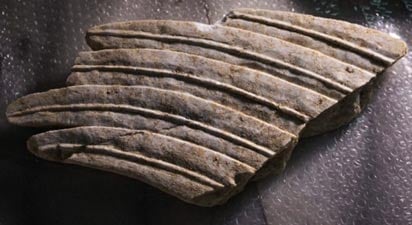
Part of a sphinx’s wing found in the Amphipolis tomb. Credit: Greek Ministry of Culture
The head has been described as an “exceptional” work of art. It depicts a woman wearing some type of crown or hat, and with long curls falling over her left shoulder. Traces of red paint could be found on the sphinx’s hair.
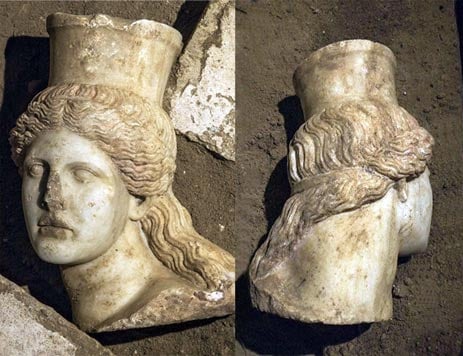
One of the sphinx heads has now been found in the Amphipolis Tomb. Credit: Greek Ministry of Culture.
Yesterday, archaeologists made another significant discovery – a marble door weighing 1.5 tons that belongs to the third chamber. The door measures 2.9 by 1.5 meters and is in good condition, apart from a section missing from the lower right portion.
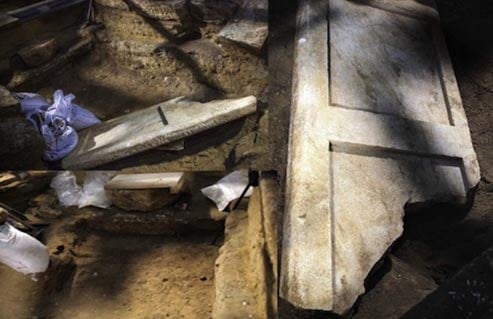
Newly discovered marble door. Credit: Greek Ministry of Culture
Several days ago, the Ministry made the disappointing announcement that the third chamber of the tomb is the last one, and what they had thought was a door leading into a fourth chamber was actually a place where a marble stanchion had been removed, providing further evidence that looting took place in antiquity.
However, in an exciting development, archaeologists have just uncovered a vault measuring 4 by 2.1 meters dug into the natural slate floor. It’s floor is sealed with limestone, which is partly intact. The vault is filled with soil but archaeologists have so far managed to dig out to a depth of 1.4 meters, although it appears to go much deeper. Could this be the final resting place of the tomb’s owner? Only time will tell.
Source: http://www.ancient-origins.net/
Thursday, October 30, 2014
Mexico archaeologists reach end of Teotihuacan tunnel, find offering and 3 chambers beyond

MEXICO CITY (AP) — A yearslong exploration of a tunnel sealed almost 2,000 years ago at the ancient city of Teotihuacan yielded thousands of relics and the discovery of three chambers that could hold more important finds, Mexican archaeologists said Wednesday.
Project leader Sergio Gomez said researchers recently reached the end of the 340-foot (103-meter) tunnel after meticulously working their way down its length, collecting relics from seeds to pottery to animal bones.

A large offering found near the entrance to the chambers, some 59 feet (18 meters) below the Temple of the Plumed Serpent, suggests they could be the tombs of the city's elite.
"Because this is one of the most sacred places in all Teotihuacan, we believe that it could have been used for the rulers to ... acquire divine endowment allowing them to rule on the surface," Gomez said.
Unlike at other pre-Columbian ruins in Mexico, archaeologists have never found any remains believed to belong to Teotihuacan's rulers. Such a discovery could help shine light on the leadership structure of the city, including whether rule was hereditary.
"We have not lost hope of finding that, and if they are there, they must be from someone very, very important," Gomez said.
So far Gomez's team has excavated only about 2 feet (60 centimeters) into the chambers. A full exploration will take at least another year.
Initial studies by the National Institute of Anthropology and History show the tunnel functioned until around A.D. 250, when it was closed off.
Teotihuacan long dominated central Mexico and had its apex between 100 B.C. and A.D. 750. It is believed to have been home to more than 100,000 people, but was abandoned before the rise of the Aztecs in the 14th century.
Today it is an important archaeological site on the outskirts of Mexico City and a major tourist draw known for its broad avenues and massive pyramids.

Source: www.news.ne
Subscribe to:
Posts (Atom)