Monday, October 26, 2020

Sunday, October 25, 2020
Thursday, October 22, 2020
Tuesday, November 4, 2014
First Ever Video Shot Inside Amphipolis Tomb Released, Plus More Discoveries

The Greek Ministry of Culture has released the first ever video footage taken inside the Amphipolis tomb at Kasta Hill in northern Greece. The footage shows the meticulous work being carried out by archaeologists as they sort through tons of soil and debris to uncover marble walls and floors, and the stunning mosaic depicting the abduction of Persephone.
In addition, the Greek Ministry has announced the discovery of parts of the Sphinxes’ wings and one of the missing heads belonging to a sphinx guarding the entrance to the tomb, which was found under collapsed slabs of floor in the third chamber.
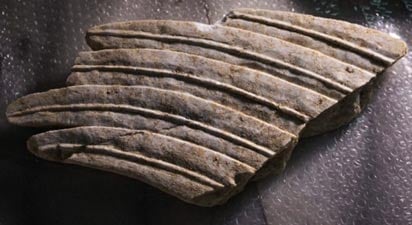
Part of a sphinx’s wing found in the Amphipolis tomb. Credit: Greek Ministry of Culture
The head has been described as an “exceptional” work of art. It depicts a woman wearing some type of crown or hat, and with long curls falling over her left shoulder. Traces of red paint could be found on the sphinx’s hair.
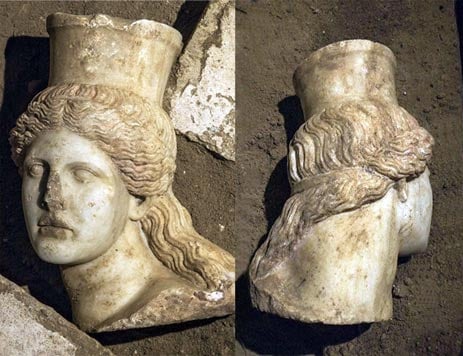
One of the sphinx heads has now been found in the Amphipolis Tomb. Credit: Greek Ministry of Culture.
Yesterday, archaeologists made another significant discovery – a marble door weighing 1.5 tons that belongs to the third chamber. The door measures 2.9 by 1.5 meters and is in good condition, apart from a section missing from the lower right portion.
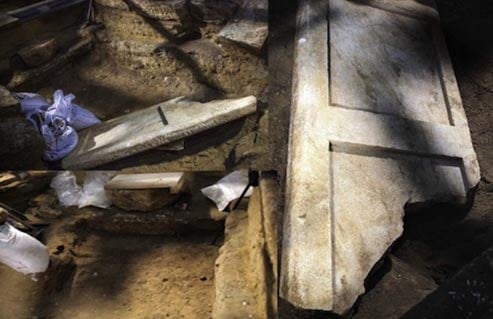
Newly discovered marble door. Credit: Greek Ministry of Culture
Several days ago, the Ministry made the disappointing announcement that the third chamber of the tomb is the last one, and what they had thought was a door leading into a fourth chamber was actually a place where a marble stanchion had been removed, providing further evidence that looting took place in antiquity.
However, in an exciting development, archaeologists have just uncovered a vault measuring 4 by 2.1 meters dug into the natural slate floor. It’s floor is sealed with limestone, which is partly intact. The vault is filled with soil but archaeologists have so far managed to dig out to a depth of 1.4 meters, although it appears to go much deeper. Could this be the final resting place of the tomb’s owner? Only time will tell.
Source: http://www.ancient-origins.net/
Thursday, October 30, 2014
Mexico archaeologists reach end of Teotihuacan tunnel, find offering and 3 chambers beyond

MEXICO CITY (AP) — A yearslong exploration of a tunnel sealed almost 2,000 years ago at the ancient city of Teotihuacan yielded thousands of relics and the discovery of three chambers that could hold more important finds, Mexican archaeologists said Wednesday.
Project leader Sergio Gomez said researchers recently reached the end of the 340-foot (103-meter) tunnel after meticulously working their way down its length, collecting relics from seeds to pottery to animal bones.

A large offering found near the entrance to the chambers, some 59 feet (18 meters) below the Temple of the Plumed Serpent, suggests they could be the tombs of the city's elite.
"Because this is one of the most sacred places in all Teotihuacan, we believe that it could have been used for the rulers to ... acquire divine endowment allowing them to rule on the surface," Gomez said.
Unlike at other pre-Columbian ruins in Mexico, archaeologists have never found any remains believed to belong to Teotihuacan's rulers. Such a discovery could help shine light on the leadership structure of the city, including whether rule was hereditary.
"We have not lost hope of finding that, and if they are there, they must be from someone very, very important," Gomez said.
So far Gomez's team has excavated only about 2 feet (60 centimeters) into the chambers. A full exploration will take at least another year.
Initial studies by the National Institute of Anthropology and History show the tunnel functioned until around A.D. 250, when it was closed off.
Teotihuacan long dominated central Mexico and had its apex between 100 B.C. and A.D. 750. It is believed to have been home to more than 100,000 people, but was abandoned before the rise of the Aztecs in the 14th century.
Today it is an important archaeological site on the outskirts of Mexico City and a major tourist draw known for its broad avenues and massive pyramids.

Source: www.news.ne
Friday, July 11, 2014
Cursed Warship Revealed With Treasure Onboard

It was the largest and fiercest warship in the world, named the Mars for the Roman god of war, but it went up in a ball of flames in a brutal naval battle in 1564, consigning 800 to 900 Swedish and German sailors and a fortune in gold and silver coins to the bottom of the Baltic Sea (map).
Now, a few years after the ship's discovery, researchers have concluded that the one-of-a-kind ship is also the best preserved ship of its kind, representing the first generation of Europe's big, three-masted warships.
Naval historians know a lot about 17th-century ships, but very little about warships from the 16th century, said Johan Rönnby, a professor of maritime archaeology at Södertörn University in Sweden, who is studying the 197-foot-long (60 meter) wreck.
"It's a missing link," said Rönnby, whose work is funded in part by a grant from the National Geographic Society's Global Exploration Fund. The 1500s is an important period, he said, because it's when big three-masted warships started being built.
Researchers have found cargo from early warships called galleons—slightly later iterations of the type of vessel the Mars exemplifies. And they've recovered pieces of actual ships, including the English flagshipMary Rose, which sank during a battle in 1545. But never have they found something as well preserved as the Mars.

Rönnby and his team want to leave the Mars on the seafloor and instead use three-dimensional scans and photographs to share the wreck with the world.
Rönnby, with help from Richard Lundgren—part owner of Ocean Discovery, a company of professional divers that assists in maritime archaeology work—and others, has been piecing together photomosaics and scanning the wreck to produce 3-D reconstructions. With funding from the National Geographic Society/Waitt Grants Program, they are working this summer to complete their scans of the entire ship.
Bringing a ship out of the ocean is expensive, and it can cause significant harm to artifacts. The laser scans Lundgren and colleagues have taken are accurate to within 0.08 inches (2 millimeters)—more than enough to satisfy most researchers.
Using some relatively new tools and methods, archeologists now have a chance to reconstruct the last minutes of the ship and the souls onboard, Lundgren said, and gain some insight into how people behaved on a battlefield.
Finding the Mars
Treasure hunters, archaeologists, and history aficionados have sought the Mars over the years. But they were unsuccessful until the late spring of 2011, when a group of divers located one of maritime archaeology's greatest finds in 246 feet (75 meters) of water. (See "5 Shipwrecks Lost to Time That Archaeologists Would Love to Get Their Hands On.")
Legend has it that a specter rose from the inferno to guard the Mars, the pride of the Swedish navy, against ever being discovered.
The discovery was the culmination of a 20-year search by Lundgren, along with his brother Ingemar and their colleague Fredrik Skogh. The men had dreamed of finding the mighty Mars since making a childhood visit to a Stockholm museum housing another iconic Swedish warship, named the Vasa. Richard and Ingemar Lundgren became professional divers in part because of that dream.

War Machine
The Mars sank on May 31, 1564, off the coast of a Swedish island calledÖland (map). She came to rest on the seafloor tilted to her starboard, or right, side. Low levels of sediment, slow currents, brackish water, and the absence of a mollusk called a shipworm—responsible for breaking down wooden wrecks in other oceans in as little as five years—combined to keep the warship in remarkable condition.
What makes this find even more exciting, said Lundgren, is that the Marsdidn't sink because of a design flaw or poor seamanship.
"Mars was a functioning war machine that performed extremely well in battle," he explained. She sank loaded to the gills with cannons—even her crow's nests had guns—sailors, and all the accoutrements needed to run a ship built for war (including eight different kinds of beer).
This warship had "totally unheard of firepower" for her time, said Lundgren. And it's those cannons that played a role in her demise.
A Fiery End
The Mars went down while engaged with a Danish force allied with soldiers from a German city called Lübeck. The Swedes routed the Danes on the first day of battle, said Rönnby. So on the second day, the Germans decided to press their luck.
German forces began lobbing fireballs at the Mars and eventually succeeded in pulling alongside the burning ship so soldiers could board her. As gunpowder on the warship fueled the inferno, the heat became so intense that cannons began to explode, said Rönnby.
Those explosions eventually sank the warship. Legend, however, tells a slightly different story.
The Swedish kings at the time were busy trying to consolidate their position, Rönnby explained. "[But] the Catholic Church was a problem for the new kings because it was so powerful," he said. So in trying to diminish the church's power, monarchs like Erik XIV—who commissioned the Mars—would confiscate church bells, melt them down, and use the metal to make cannons for their new warships.
Legend has it that carrying those repurposed church bells doomed theMars to a watery grave. The warship carried either 107 or 173 cannons of many different sizes.
A Time Machine
"It's not just a ship, it's a battlefield," said Rönnby. Diving on the wreck, "you're very close to this dramatic fire on board, people killing each other, everything was burning and exploding," he said.
In fact, when Lundgren and colleagues brought a piece of the ship's hull to the surface, they noticed a charred scent wafting from the burnt wood.
"In the end, I think, that's the aim of archaeology—to discuss ourselves and the human aspects of a site," Rönnby said.
Source: National Geographic
Wednesday, June 25, 2014
Has the mystery of the Lost Persian Army finally been solved?

The final resting place of a 50,000-strong Persian army which was swallowed up in a cataclysmic sandstorm in the Sahara Desert around 524 BC is one of the greatest mysteries in ancient history. Many, over the years, have claimed to have found the lost army, but most have been proven to be hoaxes. Now a Dutch archaeologists believes he has solved the mystery of what happened to the ill-fated army some 2,500 years ago.
According to the Greek historian Herodotus, Cambyses II, the oldest son of Cyrus the Great, King of Persia, sent his army to destroy the Oracle of Amun at Siwa Oasis after the priests there refused to legitimize his claim to Egypt. The army of 50,000 men entered Egypt’s western desert near Luxor but halfway through, a massive sandstorm sprang up and reportedly buried them all.
"A wind arose from the south, strong and deadly, bringing with it vast columns of whirling sand, which entirely covered up the troops and caused them wholly to disappear," wrote Herodotus.

Although many Egyptologists regard the story as a myth, many expeditions have taken place in search of the remains of the lost soldiers. Most came back completely empty-handed, while others claiming to have found the remains have been proven false.
In 2009, two Italian archaeologists announced that they located human remains, tools and weapons near Siwa Oasis in Egypt dating to the age in which the army disappeared. However, this too is questionable and has been dismissed by many scholars on the basis of the fact that they chose to announce them in a documentary film rather than a scientific journal. Furthermore, the two researchers also happen to be the filmmakers who produced five controversial African shockumentaries in the 1970s.

The bones claimed by Italian archaeologists to be the remains of Cambyses' legendary army. It is highly questionable that the bones would have remained in a pile out in the open like this for 2,500 years if they were indeed the lost Persian army.
Professor Olaf Kaper, an archaeologist at Leiden University in the Netherlands, believes he knows what really happened to the lost army. “Some expect to find an entire army, fully equipped. However, experience has long shown that you cannot die from a sandstorm,” said Kaper, as reported by Sci-News.
Professor Kaper argues that the lost army of Cambyses II did not disappear, but was defeated. According to Kaper, the army’s final destination was the Dakhla Oasis – the location of the troops of the Egyptian rebel leader Petubastis III.

Kaper maintains that the fate of the army remained unclear for such a long time because the Persian King Darius I, who ended the Egyptian revolt two years after Cambyses II’s defeat, attributed the embarrassing defeat of his predecessor to a sandstorm in order to save face, and this became the accepted account of what happened.
Excavations in the Dakhla Oasis have revealed titles of the Egyptian rebel leader Petubastis III carved on ancient temple blocks, which suggests that it was a stronghold at the start of the Persian period. Hopefully further work will be undertaken to follow up this promising lead, which may solve one of archaeology's biggest outstanding mysteries.
Source: AO
Subscribe to:
Posts (Atom)