Tuesday, May 20, 2014

Metropolitan Museum releases thousands of ancient images to public domain


The Metropolitan Museum of Art in New York has just announced the release of more than 400,000 high-resolution digital images into the public domain from its world-renowned collection, according to a news release in Art Daily.

The now freely available images include thousands of ancient figurines, reliefs, paintings, manuscripts, and other artifacts spanning a period of 10,000 years, and covering all the great civilizations of our ancient past, as well as hundreds of cultures across the globe.

The new initiative called Open Access for Scholarly Content (OASC), means that images may be downloaded directly from the Museum’s website for non-commercial use without permission from the Museum and without a fee.  OASC was developed as a resource for students, educators, researchers, curators, academic publishers, non-commercial documentary filmmakers, and others involved in scholarly or cultural work. Prior to the establishment of OASC, the Metropolitan Museum provided images upon request, for a fee, and authorization was subject to strict terms and conditions. 

“Through this new, open-access policy, we join a growing number of museums that provide free access to images of art in the public domain. I am delighted that digital technology can open the doors to this trove of images from our encyclopedic collection,” said Thomas P. Campbell, Director and CEO of The Metropolitan Museum of Art.

Here we feature just a tiny sample of the magnificent collection now available to the public.
Fragment of a Byzantine Floor Mosaic with a Personification of Ktisis (500–550 AD).

This fragment is an example of the exceptional mosaics created throughout the Early Byzantine world in the first half of the sixth century. The rod that she holds, the measuring tool for the Roman foot, identifies her as a personification of the abstract concept of "Ktisis," or Foundation, and symbolizes the donation, or foundation, of a building. Personifications of abstract ideas, as developed by the Stoic philosophers, remained popular in the Early Christian era. 
Neo-Assyrian relief carving (ca. 883–859 B.C.)

The palace rooms at Nimrud were decorated with large stone slabs carved in low relief, with brightly painted walls and ceilings and sculptural figures guarding the doorways. The throne room contained narrative scenes commemorating the military victories of Ashurnasirpal, while in other areas of the palace were protective figures and images of the king and his retinue performing ritual acts. On this relief slab the king Ashurnasirpal II wears the royal crown, a conical cap with a small peak and a long diadem. He holds a bow, a symbol of his authority, and a ceremonial bowl. Facing him, a eunuch, a "beardless one," carries a fly whisk and a ladle for replenishing the royal vessel. The peaceful, perhaps religious character of the scene is reflected in the dignified composure of the figures. 
Reproduction of the Bull Leapers Fresco, attributed to Emile Gilliéron père. Excavated 1901 in the Court of the Stone Spout, Knossos. (ca. 1425–1300 BC) 

The well-known fresco at Knossos of a leaping bull was one of at least three similar scenes. The figural portion is framed at top and bottom by elaborate borders of overlapping variegated rock patterns between narrow bands with dentil patterns. There is no evidence to support the restored rock pattern at the sides. Two white-skinned females and a red-skinned male engage the bull, which is rendered in a flying gallop. Bull sports had a long history in Minoan art stretching back to the third millennium B.C. When this reproduction was first exhibited at the Metropolitan Museum it was identified as a circus scene. More recently, scholars have suggested that the scene represents ritual practices, perhaps symbolizing human domination over nature. The original is in the Archaeological Museum of Herakleion, Crete.
Chakrasamvara Mandala on cloth. Nepal (ca. 1100 AD)

This mandala, or ritual diagram, is conceived as the palace of the wrathful Chakrasamvara and his consort Vajravarahi, seen together at the center of the composition. These deities are important to the Newar tradition of Nepal as well as in Tibet, embodying the esoteric knowledge of Buddhist texts, the Yoga Tantras. The central divinities are surrounded by six goddesses, each set on a stylized lotus petal that forms a vajra—a feature that suggests an early date for this work. Framing the mandala are the eight great burial grounds of India, each of which is presided over by a deity beneath a tree. The cemeteries are appropriate places for meditation on Chakrasamvara and are emblematic of the various realms of existence. The lower register contains five forms of the goddess Tara as well as a tantric adept to the left and two donors on the right. This mandala is one of the earliest large-scale paintings to survive from Nepal. 
Reproduction of the "Ladies in Blue" fresco. Emile Gilliéron fils, 1927.  Original on painted plaster (ca. 1525–1450 B.C.).
This group of three women was originally restored by E. Gillieron, pere on the basis of other fragments of frescos excavated before 1914 at Knossos. This copy reproduces the few fragments of burnt and abraded original fresco, represented as slightly offset from the restoration, and shows the extent to which the Gillierons recreated the scene. The original is in the Archaeological Museum of Herakleion, Crete.
View the entire collection here.
Source: AO

Sunday, May 18, 2014

ISIS Destroys 3000 Year-old Assyrian Artifacts in Syria

(AINA) -- According to a report from the websitewww.apsa2011.com, the Islamic State of Iraq and the Levant (ISIL, also known as ISIS) has destroyed Assyrian statues and artifacts believed to be 3000 years old.
The Assyrian archaeological artifacts were illegally excavated from the Tell Ajaja site.
Looting of Assyrian artifacts was also carried out in Iraq soon after 2003 by Al-Qaeda, which sold the artifacts to finance its operations. The looting occurred at the Baghdad Museum (AINA2003-04-19) as well as archaeological sites which were left unguarded as a result of the collapse of the government of Saddam Hussein (AINA 2005-02-17).


Source: AINA


Tuesday, April 29, 2014

Egyptologists discover unusual structure with a possible early depiction of Jesus

A team of Catalan Egyptologists from the Catalan Egyptology Society and University of Barcelona claim to have found one of the earliest-known pictures of Jesus in a 6th century tomb unearthed in Upper Egypt, according to a news report in La Vanguardia.  The image found painted on the wall of the Coptic Christian crypt depicts a young man with curly hair and a short tunic, with a hand raised in blessing.

The tomb is located in the ancient city of Oxyrhynchus at Al Bahnasa, approximately 160 km south of Cairo.  Previous digs in ancient city of Oxyrhynchus have unearthed temples dedicated to Osiris, the Egyptian god of the afterlife, but the exact nature of the latest discovery has left the experts baffled but excited.

The crypt was discovered inside an unusual underground structure measuring 8 x 3.75 metres, the purpose of which researchers are unsure about. The subterranean stone structure was found in very good condition with walls fitted with niches were statues probably stood.  Although the research team does not know what it was used for, its “importance seems unquestionable”, according to head of the expedition, Josep Padró, who has spent over 20 years excavating sites in the area. One possibility, according to Padró, is that it is an Osireion or Serepeum (temple of the god Serapis, the Hellenised form of Osiris).

The excavation of the structure involved a massive effort to remove very heavy debris (more than 45 tonnes), in a meticulous operation overseen by an architect and an engineer.  The researchers believe the debris was placed there purposely, possibly to protect the tomb from looters. 
The team had to remove more than 45 tonnes of debris. Credit: La Vanguardia.
The research team believes the burial chamber belonged to a priestly family and a scribe, based on the discovery of an inkwell still full of ink.  “The walls are covered with 5 or 6 layers of paint, the last corresponding to the time of the early Coptic Christians,” said Padró. It “could be a very primitive image of Jesus Christ, similar to those found in Roman catacombs, while not ruling out that it could correspond to a Saint.”
If found to be an image of Jesus, which may be established following translations of Coptic inscriptions located around the image, it would be among the earliest known representations of Jesus.
The oldest known portrait of Jesus, known as ‘The Healing of the Paralytic’, was found in Dura-Eurpos, Syria and dates to about 235 AD.  It shows Jesus as a beardless young man of authoritative and dignified bearing. He is depicted dressed in the style of a young philosopher, with close-cropped hair and wearing a tunic and cloak – signs of good breeding in Greco-Roman society. From this, it is evident that some early Christians paid no heed to the historical context of Jesus and visualised him solely in terms of their own social context, as a quasi-heroic figure, without supernatural attributes such as a halo (a fourth-century innovation).
The Healing of the Paralytic: oldest known wall painting depicting Jesus, 235 AD. Image source.
The Egyptian Ministry of Culture is now taking over responsibility for work being carried out at the archaeological site.  Currently, the painting remains protected while translations are underway, which will hopefully shed more light on the image and the function of the enigmatic structure.
Featured image: The archaeological site at Oxyrhynchus on the left and the Coptic painting, possibly of Jesus, covered by a protective layer on the right. 
Credit: La Vanguardia 

Monday, April 28, 2014

Could newly discovered ancient stairs lead to more treasures under Vishnu Temple?


Archaeologists have unearthed a set of three ancient granite steps and building foundations near the northern entrance to the Sree Padmanabhaswamy Temple, located in Thiruvananthapuram, the capital city of the State of Kerala in India, according to reports in the New Indian Express.  The temple, which is dedicated to Lord Vishnu, is famous for its underground tunnels and the billion-dollar treasure uncovered in its secret vaults several years ago.

“The basement made of brick and laterite stone could be part of the temple complex in the past,” said Archaeology Department director G Premkumar.

Even after three years since the world came to know about the billion-dollar treasure trove in the secret vaults of Sree Padmanabhaswamy Temple, the network of underground tunnels leading to the temple complex still remains a mystery, and many are concerned that the state police have not shown any interest in monitoring the subterranean passages in the temple complex, which are clearly a security risk to the priceless treasures laying beneath the temple, as some of the passages may still be functional.

Historians say that the tunnels were built between 12th century and 18th century, during which time the Travancore Kingdom, a former Hindu Kingdom ruled by the Travancore royal family, faced threat from various quarters, including the Mughal invaders, the Dutch and the British East India Company.

The history of the Sree Padmanabhaswamy Temple dates back to 8th century. It is one of 108 sacred Vishnu temples or Divya Desams, the holiest abodes of the Lord Vishnu that are mentioned in the works of the Tamil Azhvars (saints). The presiding deity of this temple is Lord Vishnu, reclining on Anantha, the hooded Serpent. 

The 32 kg, solid gold statue of Lord Vishnu reclining on Anantha, the hooded Serpent. Photo source.

In 1750, Marthanda Varma, one of the Travancore kings dedicated the kingdom of Travancore to Lord Padmanabha. Marthanda Varma vowed that the royal family would rule the state on behalf of Lord and he and his descendants would serve the kingdom as Padmanabha Dasa (the Servant of Lord Padmanabha). Since then, the name of every Travancore King was preceded by the title Padmanabha Dasa.

Local legend spoke of immense riches sealed within the thick stone walls and vaults of the temple by the Travancore kings, and the stories were right. Several years ago, researchers uncovered a remarkable collection of treasures valued at an incredible US$5.3 billion.  The treasures include thousands of gold coins, rare valuable gems, precious diamonds, 1,200 gold chains, gold crowns, 400 gold necklaces, more than 2,000 gold ornaments, gold plates, gold chains weighing up to 10.5 kilograms and measuring 18 feet in length, the golden idol of Padmanabha Swamy, 4-foot-tall golden statue of Lord Vishnu studded with precious emeralds, gold staffs, gold utensils, gold umbrellas, 2,500 gold pots and numerous golden rings. 

A tiny fraction of the solid gold items found in the vaults of the temple. Photo source.

The discovery of the treasures solidified the status of the Sree Padmanabhaswamy temple as one of the wealthiest temples in India, and the question has been raised as to whether the newly discovered stairs could lead to yet more treasures under the ancient temple. 

READ ALSO: Ancient UFO Discovered Under Temple in India.


Source: AO

Sunday, April 27, 2014

The Man Rocks of Mersin Province, Turkey


Adamkayalar (literally "man-rocks") is a site in Mersin Province, Turkey, famous for its rock carved figures. This site lies on the southern slope of the Taurus Mountains, and is several kilometres north of the Mediterranean coast. There are 17 human figures carved into 9 niches. Of these figures, there are 11 males, 4 females, and 2 children. The date of these figures is unknown, although it has been speculated that they were carved between the 4th century B.C. and the 2nd century A.D. Due to the stylistic changes that can be detected in these figures, it has been suggested that they were carved overtime.
As there are no written records about these carvings, much is unknown about them. It is claimed that Adamkayalar was a site for a mortuary cult. This may be supported by the figure lying on a bed, which represents the deceased (this is a common motif in the Roman world to depict a dead person). In addition, it is claimed that there are inscriptions on some of the figures that provide some information about the people who built the tombs, and the people buried there. Yet, the poor preservation of these inscriptions means that only fragmentary information about the figures can be gained from them.

Since no literary evidence is available, and there is little epigraphic evidence as well, we might turn to archaeology to aid our understanding of these enigmatic carvings. First of all, one could consider the position of these monuments in the landscape. In ancient times, the valley road that passed through Adamkayalar would have been important in connecting the Mediterranean coast with the hinterland. Therefore, people who passed through Adamkayalar would have seen and been ‘seen’ by these figures. Whoever carved these figures would almost certainly have been powerful individuals in life, and attempted to immortalise their authority by stamping it into the landscape.


Many of these figures depict armed warriors. Perhaps there was an elite class of warriors who controlled this region. Perhaps, that was an idealistic portrayal of the men in power. It is not surprising that the ruling class in this area had to/wanted to be portrayed as tough military men. After all, Cilicia was home to the notorious Cilician pirates. These were the pirates who once kidnapped Julius Caesar, and held him for ransom. They met a sticky end though, when Caesar avenged himself after the ransom was paid.
Nevertheless, Adamkayalar was not merely a monument for the display of military might. One scene is said to show a soldier leaving his daughter and wife. In addition, there is a little dog as well, which is supposed to symbolise loyalty and represent the unity of this family unit. Hence, there is an element of intimacy in these carvings, perhaps a statement that family bonds cannot be broken, even by death.

Perhaps it is this depiction of the family that sets Adamkayalar apart from most other rock carved figures of the Near Eastern region. There are many well-known rock carvings in the Near East, such as that of the Darius I at Behistun and that of the Sassanian kings at Naqsh-i-Rustam. Yet, all these carvings were commissioned by kings for the display of imperial might. While the carvings of Adamkalayar may, to some extent, be a statement of military power, it also shows a softer side, in which the family is represented. It is perhaps this familial scene that connects us to the people depicted in the carvings. It is a shared human emotion, one of sorrow in the face of death, and the belief that our loved ones, though gone, will never be forgotten. 


Source:AO

Saturday, April 26, 2014

Old satellite images reveal lost cities and previously unknown ancient sites


Archaeologists have discovered numerous archaeological sites scattered across the Middle East thanks to work on the new Corona Atlas of the Middle East, which features Cold-War satellite images from Egypt to Iran, and encompassing the Fertile Crescent, one of the cradles of civilization and location of some of humanity’s earliest cities. According to a report in the National Geographic, the satellite photos have tripled the number of known archaeological sites across the region, revealing thousands of ancient cities, roads, canals, and other ruins. 


There were already around 4,500 known archaeological sites across the Middle East, but the satellite images have revealed another 10,000 that were not previously known about.  The largest sites, with some covering more than 123 acres, are believed to be Bronze Age cities which ancient walls and citadels.

"Some of these sites are gigantic, and they were completely unknown," says atlas-team archaeologist Jesse Casana of the University of Arkansas, who presented the results. "We can see all kinds of things—ancient roads and canals. The images provide a very comprehensive picture."

This 1961 satellite photo shows Tell Rifaat in northwest Syria; it's now completely surrounded by a modern town. Photo credit: Internet Archaeology / Jesse Casana, Jackson Cothren and Tuna Kalayci 

The advantage of the satellite images, explained Casana, is that they were taken between 1960 and 1972, a period of time before cities such as Mosul in Iraq and Amman in Jordan overran the many archaeological sites near them.  Many ancient sites have since been flooded by the construction of dams, and industrial farming and irrigation also obscured roads and sites, which are still clearly visible in the spy-satellite images.

The massive coverage of the photos also means that, not only does it reveal new places to excavate, it also provides a way to “look across the whole Middle East and see how it was connected," said Casana.

However, the sheer quantity of ancient sites provides a real challenge for the field of archaeology, which must handle ever larger amounts of data from excavation sites, and there are simply not enough archaeologists, and not enough funding to tackle all 10,000 sites which have been pinpointed in the images.


"This is big data," said science scholar Eric Kansa of the Alexandria Archive Institute of San Francisco. "We have the opportunity to really blow up the scale of our efforts in archaeology." Featured image: A reconstruction of a Mesopotamian city. Satellite images have now revealed traces of such cities which had been lost to the pages of history. 

Source: AO

Wednesday, April 23, 2014

Two Saiti tombs unearthed near Egypt's Minya

Two 26th Dynasty tombs have been discovered at Al-Bahnasa archaeological site in Middle Egypt, containing mummies, coins and even mummified fish

A Spanish-Egyptian team has uncovered two 26th Dynasty tombs during excavation work at Al-Bahnasa archaeological site in Minya.
Al-Bahnasa was known in the ancient Egyptian era as the town of Pr-Medjet, developing in the Graeco-Roman period to be the city of Oxyrhynchus.
According to a statement by the Ministry of Antiquities, the first tomb belongs to a scribe whose his name is not yet identified but was important, having influence on Egypt’s cultural sphere. The tomb houses some of his funerary collection. A bronze inkwell and two small bamboo pens were found beside the deceased’s mummy, which is in a very good state of preservation.
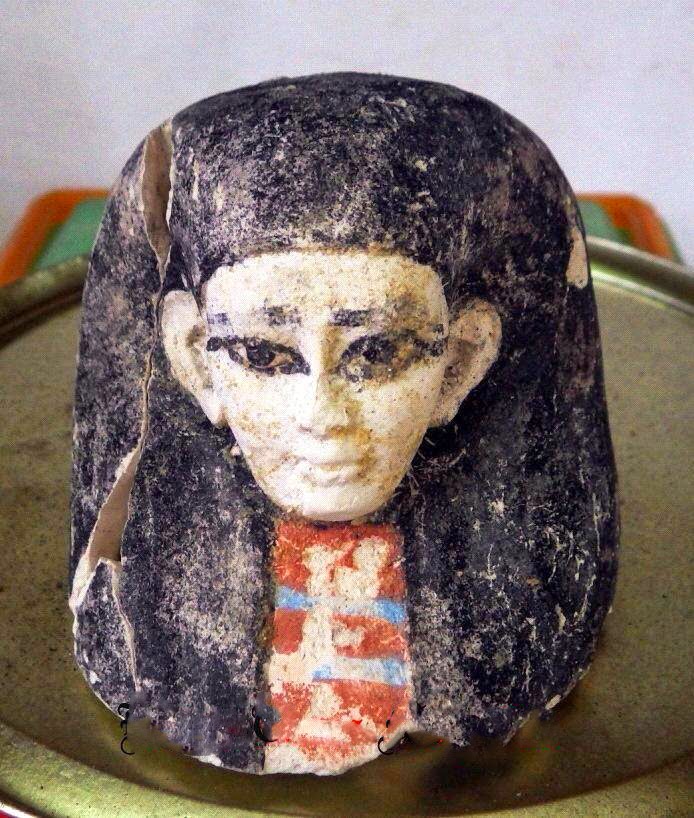
Ali El-Asfar, head of the Ancient Egyptian Antiquities Sector at the Ministry of Antiquities, explained that a large number of mummified fishes were also unearthed inside the tomb as well as the lid of a canopic jar. Among the fishes is one representing the symbol of the city. “It is the first time to find stuffed or mummified fishes inside a tomb,” said El-Asfar.
The second tomb, said Mohamed Ibrahim, minister of antiquities, belongs to a priest who was the head of a family many of whose members were priests in the Osirion Temple. This temple was uncovered recently two kilometres west of the tomb.
A large collection of stone sarcophagi, which some are broken, was found along with canopic jars carved in alabaster and bearing hieroglyphic texts as well as a collection of bronze Osirian statuettes. A collection of bronze coins was found inside the second tomb.
The large number of coins reveals that the Saiiti era was one of Egypt’s flourishing periods. Osireion statues and bronze coins dating back to the 26th Dynasty were also found in the tomb.
Joseph Padro, head of the Spanish mission, said: “The Spanish mission of Barcelona University has been working in Egypt in cooperation with the Ministry of Antiquities since 1992. During this period, many discoveries were made and this discovery comes as a reward for excavation work this season.”


Source: ArhamOnline