Thursday, March 20, 2014

Russian scientists: We have a "high chance" of cloning a wooly mammoth

An exquisitely preserved wooly mammoth is currently undergoing an autopsy in Siberia. Some experts believe they'll be able to extract high quality DNA and cells from the remains which could conceivably be used to clone the extinct mammal. The question now is, should we?

Back in May of last year, Russian scientists discovered the remains of the mammoth partially embedded in a chunk of ice at an excavation site on Lyakhovsky Island, the southernmost group of the New Siberian Islands in the Arctic seas of northeastern Russia.
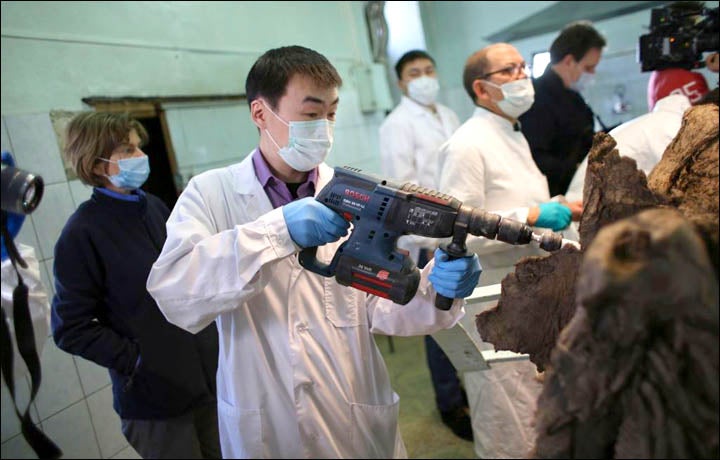
Russian scientists: We have a "high chance" of cloning a wooly mammothThe samples were so amazingly well-preserved that fresh flowing blood was found within muscle tissue. Now, some 10 months later, an international team of biologists are conducting a thorough autopsy in Yakutsk, capital of the Sakha Republic (also called Yakutia). The team is comprised of scientists from Russia, the UK, the USA, Denmark, South Korea, and Moldova.


An Incredible Find

As reported by the Siberian Times, the scientists have dissected the mammoth, revealing 43,000-year-old soft tissue that's better preserved than those of a human buried for six months.
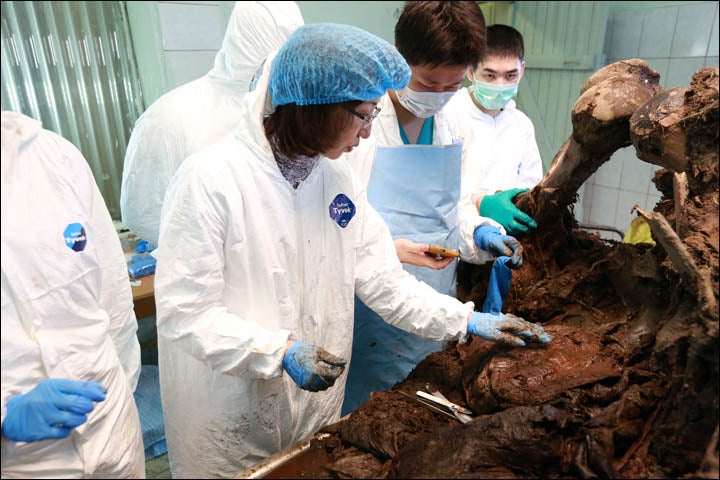
Russian scientists: We have a "high chance" of cloning a wooly mammothSEXPAND
Viktoria Egorova, chief of the Research and Clinical Diagnostic Laboratory of the Medical Clinic of North-Eastern Federal University, told Siberian Times that:
The tissue cut clearly shows blood vessels with strong walls. Inside the vessels there is haemolysed blood, where for the first time we have found erythrocytes. Muscle and adipose tissues are well preserved. We have also obtained very well visualised migrating cells of the lymphoid tissue, which is another great discovery. The upper part of the carcass has been eaten by animals, yet the lower part with the legs and, astonishingly, the trunk are very well preserved.
We also have the mammoth's liver — very well preserved, too, and looks like with some solid fragments inside it. We haven't managed to study them yet, but the first suggestion is that possibly these are kidney stones. Another discovery was intestines with remains of the vegetation the mammoth ate before its death, and a multi-chambered stomach what we've been working with today, collecting tissue samples. There is a lot more material that will have to go through laboratory research.
A full report is expected in several months.
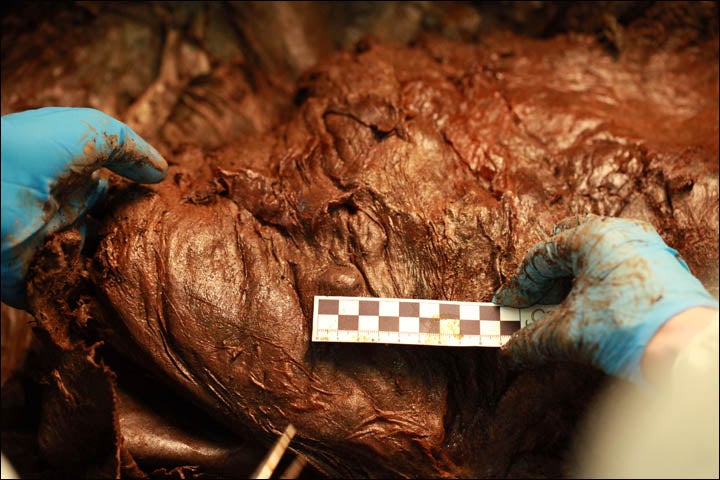
Russian scientists: We have a "high chance" of cloning a wooly mammothSEXPAND
Radik Khayrullin, the vice-president of the Russian Association of Medical Anthropologists, was quoted as saying "The data we are about to receive will give us a high chance to clone the mammoth," adding that "we must have a reason to do this, as it is one thing to clone it for scientific purpose, and another to clone for the sake of curiosity."

How to Clone a Mammoth

Despite the optimistic words, the scientists have yet to uncover the most critical element to cloning: actual living cells. If they can find some — and that's still a big if at this point — they'd have to inscribe them with the mammoth's genome. And indeed, the biologists are currently searching for the least damaged snippets of DNA, and most especially nuclear DNA, to create a "working" wooly mammoth genome.
Assuming both these elements can be found, molecular biologists could begin the arduous task of of trying to culture germ cells from a wooly mammoth. Once this is done, they would begin to manipulate the genetic code in a kind of "cut-and-paste" process, replacing segments of elephant DNA with synthesized segments of wooly mammoth DNA until the cell's genome matches the working mammoth genome. They'd likely use George Church's MAGE (Multiplex Automated Genome Engineering) technique to do it. This would likely be a protracted process given that the evolutionary path of wooly mammoths and elephants diverged a long time ago.
Following that, the next step would involve a relatively well-established process. Scientists would splice these living cells into an elephant embryo, thus creating a chimera. A female elephant would be implanted with the resulting embryo, eventually giving birth to a veritable wooly mammoth.
It's worth noting that failure to find a living cell would not necessarily be a deal breaker. Eventually, biotechnologists may be able to create such cells from artificial DNA — but that could be decades off.

Sure, But Should We Do It?

This is not an easy question to answer as there are many factors to consider.
There's no doubt that the scientific insights gleaned from such a project would be tremendous. It's already offering scientists the opportunity to completely decode the DNA of the mammoth and decipher its DNA, which packs a lot of information.
Assuming we could clone a wooly mammoth (or any extinct animal for that matter), the process would not only help us refine our cloning and reproductive technologies, it would offer us an unprecedented glimpse into the finer workings of an animal that's been extinct for 10,000 years — both from a genomic and morphological perspective. We would be able to study a living, breathing wooly mammoth. Scientists could study how it develops and how its behavior might differ from that of extant elephants.
That said, a cloned wooly mammoth would (1) not be "socialized" in the same way its ancestors were, and (2) it would not physically (and even epigenetically) develop the same way it ancestors did given its likely environment — a laboratory setting.
As for the whole de-extinction idea, I'm quite skeptical. Most, if not all extinct animals, are gone for a reason. Many predators have been hunted to extinction, a problem still faced by today's dwindling number of large carnivores. But in most cases, now-extinct animals were victims of habitat loss — a severe problem that's confronting many of today's extant animals. Given that wooly mammoths were ice age creatures, would there even be a natural home for them in this era of global warming?
Source: io9 

Wednesday, March 19, 2014

How Elephant Armies Built the Ancient World

Without elephants, the ancient Library of Alexandria might not have existed. Every war has, as a byproduct, cultural and technological innovation: in our world, the US Civil War led to medical advancements and the Cold War put us in space. In the classical era, it was the race to build elephant armies that changed the world.
By 275 BCE, Alexandria was the largest, most beautiful city in the world. Its buildings were made of limestone and marble, imported from places worlds away. Its relatively temperate climate meant that flowers were almost always in bloom, impressing foreigners both from warmer and cooler climes. Scholars from around the world came to study and work at the Museum and Library. Life in the city was good.
But it wasn't always that way.
Just seven years earlier, when Ptolemy Philadelphos (second of the rulers of the Ptolemaic dynasty) took the throne, Alexandria was but another city on the Mediterranean. In less than one hundred years, it went from a small seaside town founded by Alexander the Great to the city you learned about in your high school world history classes, with its famous lighthouse and library. All because of elephants.

Animal War Machines

Alexander the Great first came across the impressive creatures while invading the Persian Empire. It was 331 BCE, at what is now called the Battle of Gaugamela, where Darius, king of Persia, faced down the invaders with a phalanx of fifteen elephants. In the book The Medici Giraffe, historian Marina Belozerskaya writes, "[f]lapping their ears, trumpeting, and stomping the ground with their treelike feet, the giant beasts were terrifying to the uninitiated. They threw soldiers and horses into panic, trampled them underfoot, and wreaked havoc on the battlefield." While Alexander won the battle, his interaction with those magnificent creatures would forever change him. He realized the tactical value that elephant warriors held, and began to assemble his own elephantine army, starting with the defeated Darius's fifteen animals.
Some five years later, Alexander's army found itself in India readying for battle with Porus, king of India's western region, and his one hundred elephants, their tusks adorned with body-piercing metal tips. Porus had turned elephants into battering rams and attached lances to their faces. It is no wonder that Belozerskaya describes the trumpeting of Porus's elephantine army as "blood-chilling." As before, Alexander eventually prevailed, but only barely. His army gave up after their deadly encounter with the ivory-bearing war-machines. With an army unwilling to fight, Alexander was forced to retreat. He died soon thereafter.
Elephants themselves didn't guarantee triumph, as Alexander had himself proved. "Superior strategy and command proved more decisive," writes Belozerskaya. Still, the appearance of power was important. Indeed, Alexander never managed to turn his two hundred elephants into a functional faction of his army. His campaign was so fast moving that he couldn't train the animals he rapidly acquired, all Asian elephants, Elephas maximus, originating from India. Instead, the elephants were mainly used for transporting equipment, and to stand before his throne room as a symbol of power.
Upon his death, Alexander's generals carved up the empire, splitting it amongst themselves. Seleukos took northern Syria, most of Asia Minor, Persia, and Mesopotamia. He also got most of the elephants. Since he controlled the route to India, from whence all war elephants came, he could prevent his enemies from amassing their own elephant armies. He got an additional 500 elephants in exchange for returning some land to Indian rulers. It was not long before he became known as "Master of the Elephants," creatures which soon adorned the coins minted in his kingdom, stamped opposite his own portrait.
Thanks to Alexander, and to Seleukos, the military-minded began to gauge their enemies' strength, as well as their own, by the number of elephants they commanded. It was an ancient, escalating arms race, with elephants used more for threat than as actual tools of war.
It was a problem for Ptolemy. After Alexander's death, Ptolemy gained control of Egypt, and he quickly added Cyprus and part of Libya to his kingdom. Both he and Seleukos claimed southern Syria for themselves, which was the final stop on trade routes from the Far East, and a source of precious gems, spices, and more. It was also home to the famous cedars of Lebanon, wood that was preferred for building ships and temples because it grew so straight. But Seleukos's deal with the Indians prevented Ptolemy from acquiring more elephants than he already had. In this ancient arms race, Ptolemy found himself at a loss. He was a clever strategist, though, and managed to retain his territory long enough to pass it on to his son, Ptolemy Philadelphos.

Elephants for an Empire

When Philadelphos became king, southern Syria was still disputed, claimed also by Antiochos, son of Seleukos. Like his father, Antiochos retained a monopoly on Asian elephants. Like his father, Philadelphos's army suffered a lack of the animal war machines. But Philadelphos was highly educated, and having become familiar with the writings of Aristotle and other Greek philosophers, he knew of there were supposed to be other elephants, farther south in Africa.
Philadelphos's explorers eventually discovered African elephants, Loxodonta africana, along with a group of local Africans who knew how to capture and tame them, in the kingdom of Meroe.
Meroe, in modern-day Sudan, was the transfer point along the trade routes that connected Africa and Arabia, meaning that salt, copper, iron, gold, wood, ivory, and valuable wildlife all came through the city. An agreement with Eramenes, king of Meroe, would prove useful to Philadelphos, and not just for elephants, but for access to those trade routes. For his part, Eramenes wanted access to trade with the Mediterranean. The two men, both shrewd leaders, struck a deal.
It was impossible to transport the elephants up the Nile, so Philadelphos decided that they'd return by way of the Red Sea. But the sea is shallow and rocky, and elephants are heavy. Shipwrecks were common. Philadelphos hired naval engineers to invent special sailboats calledelephantagoi, meaning "elephant drivers," that could get the job done.
Those that survived the 8-day voyage without sinking would land at Berenike, a port city that Philadelphos built to facilitate his elephant transfer. Along with elephants, the port also received ivory, tortoiseshell, rhinoceros horn, spices, frankincense, myrrh, and human slaves. It was also the place where Indian trading partners sent their wares by sea: diamonds, sapphires, pearls, turquoise, cotton, silk, sugar, and pepper. And ointments, perfumes, and cosmetics. Antiochos may have retained control over the terrestrial trade routes with India, but suddenly Philadelphos could now get there by sea. Philadelphos hired archers to protect his ships from pirates in the waters off the Horn of Africa.
Having established trade with India, Philadelphos sent emissaries to King Asoka, grandson of the Rajah who first struck that deal with Seleukos, some decades earlier. He didn't need elephants, but what he did need were folks who knew how to train them. Anymahouts that Ptolemy had inherited from his father were likely very old by now, if alive at all. It is safe to assume that Asoka gave Philadelphos the mahouts he desired. Otherwise, he never would have been able to safely transport so many from Meroe to Egypt and on to battle in Syria.
From Berenike, the elephants and their handlers had to walk 12 days to Coptos, a city on the Nile. Philadelphos had his soldiers clear tracks, dig wells, and build shade structures along the route. Watering stations were built at twenty-mile intervals. From Coptos, the elephants were loaded onto barges and shipped north to Memphis, where they could await their dispatch. To aid the elephant caravans, Philadelphos also imported the dromedary camel, native to the Arabian Peninsula. The camels, used to walking on hot desert sand, were better equipped to carry the material goods from Berenike to Coptos.

An Elephantine Arms Race

In the winter of 274 BCE, the entire city of Alexandria celebrated a festival called the Ptolemaia, which lasted several weeks. The festival was meant to be a show-and-tell for the newly enriched city, complete with music, theater, food, and drink. The biggest spectacle was a parading re-enactment of Dionysus's return from battle in India. A giant statue of the Greek god atop an artificial 18-foot-tall elephant was followed by twenty-four chariots, each drawn by four live elephants. It was not just a celebration; it was a show of force. By parading almost one hundred elephants through the city, Philadelphos was flexing his military might. It was clear to see that the balance of power in the classical world was shifting.
In the end, it wasn't the elephants themselves that mattered to history, it was the pursuit of those elephants. It was Philadelphos's unending drive to acquire an elephant army that built Alexandria into the city it was, that led to the establishment of one of the most important civilizations in ancient history.
It's a lot like the modern space race. It may have been borne out of post-war politics, but it spawned the invention of artificial satellites, and the launching of unmanned probes to study the Moon, Venus, and Mars. It resulted in advances made in human spaceflight both in low-earth orbit and to the Moon. The space race spurred increased spending on scientific research and for education. The modern environmental movement also grew directly out of early spaceflight thanks to color photos of our pale blue dot taken by astronauts.
Arms races of all kinds tend to have as byproducts technological, cultural, and diplomatic innovation. Because he was so committed to his elephants, Philadelphos developed new trade routes and forged diplomatic ties that he used to shore up his own territories. He built entire cities from the ground up. The elephant arms race also spurred him toward technological innovation, such as the invention of a new class of transport ship. The wealth and prosperity that he enjoyed because of those trade routes – developed initially for elephants! – would allow Alexandria to become known as a place of education, of mental pursuits, the location of the greatest library in history. The sparking jewel of the Mediterranean may never have achieved the glory it had if not for the lumbering pachyderms.
[For more on the history of elephants in warfare, read The Medici Giraffe]

Source: I09

Monday, March 17, 2014

Sexual Selection Lead to White Europeans in Just the Past 5000 Years

There has been much research into the factors that have influenced the human genome since the end of the last Ice Age. Anthropologists at Johannes Gutenberg University Mainz (JGU) and geneticists at University College London (UCL), working in collaboration with archaeologists from Berlin and Kiev, have analyzed ancient DNA from skeletons and found that selection has had a significant effect on the human genome even in the past 5,000 years, resulting in sustained changes to the appearance of people. The results of this current research project have been published this week in an article entitled "Direct evidence for positive selection of skin, hair, and eye pigmentation in Europeans during the last 5,000 years" in the journal Proceedings of the National Academy of Sciences (PNAS).
For a number of years population geneticists have been able to detect echoes of natural selection in the genomes of living humans, but those techniques are typically not very accurate about when that natural selection took place. The researchers in Mainz and London now decided to take a new approach. This involved analyzing DNA from archaeological skeletons and then comparing the prehistoric data with that of contemporary Europeans using computer simulations. Where the genetic changes could not be explained by the randomness of inheritance, the researchers were able to infer that positive selection played a role, i.e., that frequency of a certain mutation increased significantly in a given population.

While investigating numerous genetic markers in archaeological and living individuals, Sandra Wilde of the Palaeogenetics Group at the JGU Institute of Anthropology noticed striking differences in genes associated with hair, skin, and eye pigmentation. "Prehistoric Europeans in the region we studied would have been consistently darker than their descendants today," says Wilde, first author of the PNAS article. "This is particularly interesting as the darker phenotype seems to have been preferred by evolution over hundreds of thousands of years. All our early ancestors were more darkly pigmented." However, things must have changed in the last 50,000 years as humans began to migrate to northern latitudes.
girl
(Photo : Facebook )
"In Europe we find a particularly wide range of genetic variation in terms of pigmentation," adds co-author Dr. Karola Kirsanow, who is also a member of the Palaeogenetics Group at Mainz University. "However, we did not expect to find that natural selection had been favoring lighter pigmentation over the past few thousand years." The signals of selection that the Mainz palaeogeneticists and their colleagues at University College London have identified are comparable to those for malaria resistance and lactase persistence, meaning that they are among the most pronounced that have been discovered to date in the human genome. The authors see several possible explanations. "Perhaps the most obvious is that this is the result of adaptation to the reduced level of sunlight in northern latitudes," says Professor Mark Thomas of UCL, corresponding author of the study. "Most people of the world make most of their vitamin D in their skin as a result UV exposure. But at northern latitudes and with dark skin, this would have been less efficient. If people weren’t getting much vitamin D in their diet, then having lighter skin may have been the best option."

"But this vitamin D explanation seems less convincing when it comes to hair and eye color," Wilde continues. "Instead, it may be that lighter hair and eye color functioned as a signal indicating group affiliation, which in turn played a role in the selection of a partner." Sexual selection of this kind is common in animals and may also have been one of the driving forces behind human evolution over the past few millennia.

"We were expecting to find that changes in the human genome were the result of population dynamics, such as migration. In general we expect genetic changes due to natural selection to be the exception rather than the rule. At the same time, it cannot be denied that lactase persistence, i.e., the ability to digest the main sugar in milk as an adult, and pigmentation genes have been favored by natural selection to a surprising degree over the last 10,000 years or so," adds Professor Joachim Burger, senior author of the study. "But it should be kept in mind that our findings do not necessarily mean that everything selected for in the past is still beneficial today. The characteristics handed down as a result of sexual selection can be more often explained as the result of preference on the part of individuals or groups rather than adaptation to the environment."


Source: SCIENCEWORLDREPORT

Saturday, March 15, 2014

Secrets of Chinese Terra-Cotta Warrior Weapons Revealed


One of the most astounding archaeological discoveries of the 20th century is arguably the life-size terra-cotta army buried alongside China's first emperor. Now, scientists have figured out how the bronze triggers for the crossbows of the 8,000 terra-cotta warriors were manufactured.
Teams of craftspeople worked in small groups to produce the bronze pieces in batches for the tomb of ancient Emperor Qin Shi Huang, according to a new study detailed in the March issue of the journal Antiquity.

Prepared for the afterlife
Historical documents suggest that soon after Emperor Qin Shi Huang ascended to the throne in 246 B.C., he began work on his tomb near Xi'an, China. When the tomb was first unearthed in the 1970s,it revealed thousands of lifelike terra-cotta statues of artisans, musicians, officials, horses and soldiers. The epic effort conscripted 700,000 laborers, many of whom were convicts or people who were in debt to the empire, said study co-author Xiuzhen Janice Li, an archaeologist who was at the University College London at the time of the new work and is now at the Emperor Qin Shi Huang’s Mausoleum Site Museum in China. [In Images: Ancient Chinese Warriors Protect Secret Tomb]
The massive undertaking had an important goal: ensuring the emperor's military power and resources in the afterlife.
As part of the huge project, craftspeople sculpted about 8,000 colorful warriors — likely using real human beings as inspiration — and those warriors wore stone armor and "wielded" lances, swords and crossbows.
But it wasn't clear exactly how these ancient weapons were made. The crossbows were made of wood or bamboo that rotted long ago, and only the tips and triggers for the bows remained, Li told Live Science.

Small workshops
To learn more about how the massive trove was built, Li and her colleagues visually inspected and measured about 216 of the five-part crossbow triggers from the mausoleum.
The lack of wear on the metal pieces suggests the weapons were never used in actual battle, but were instead built solely for the tomb, the researchers said.

In addition, the team analyzed the spots where triggers were found in the tomb, as well as the variation in the size and shape of the pieces.
The pieces were mostly uniform, suggesting the interlocking trigger parts were made in the same or nearly-identical molds and produced in small batches. Each batch of the trigger pieces was likely then assembled in small cells, or workshops, perhaps headed by an overseer.  That model contrasts with the "assembly line" hypothesis that some archaeologists thought might have been used.
Mirror of society
The organization into small workshops was similar to the structure the emperor imposed on the rest of society in ancient China, said study co-author Marcos Martinón-Torres, an archaeologist at the University College London.
"He abolished any privileges inherited by blood, and the population was divided in small groups that were collectively responsible for their adherence to imperial laws," Martinón-Torres wrote in an email to Live Science. "For example, if someone in one of these groups committed a crime, all of them were held responsible, unless they reported the culprit and allowed them to be punished."
The manufacturing technique used in the workshop also may have been used by weapon makers for the Emperor of Qin's real armies, though that's just speculation, Martinón-Torres said.
"The cellular workshop model we postulate for the weapons manufacture in the mausoleum would have also offered useful flexibility for armies on the move," he said.

Source: LiveScience

Friday, March 14, 2014

Ancient petroglyphs found by drone in southern Utah.


SALT LAKE CITY — A video recently posted on YouTube claims “Drone discovers ancient petroglyphs in Utah.”
The video was made by Bill Clary of Colorado who owns ’Got Aerials,’ a business which sells drones. His website shows several samples of video taken by drones, many in spectacular outdoor settings.
Clary claims the petroglyphs were filmed on a high canyon wall in Southern Utah, but declined to say exactly where, telling FOX 13 he is making an effort to contact the property owners.
Jerry Spangler who heads the Colorado Plateau Archeological Alliance (cparch.org) reviewed the video for FOX 13.
“What you showed me is what we call San Juan basketmaker style. Broad shoulders, pecked in outline, skinny legs. It’s a very classic style made by the basketmaker people from about 500 B.C. through around 8600,” Spangler said.
Spangler said it is possible that the petroglyphs seen in the video have gone unnoticed for centuries, perhaps longer.
He added there are likely thousands of archeological sites in Utah yet to be discovered — there are hundreds of known sites, which have not yet been fully documented.
“Some of these sites are so incredibly difficult to get to, just for safety reasons we can’t get to them,” Spangler said.
Spangler believes drones could become an invaluable research tool, but also thinks it may be hard for organizations like the Bureau of Land Management, the National Park Service, and organizations like his own to keep up with the discoveries, which people like Clary will likely make.
Spangler said looting and vandalism at archeological sites has long been a problem, and speculates that the sharing of information online will accelerate such behaviors. He hopes Clary and others will closely guard information about locations and access, noting that each discovery is unique, and future finds could unlock clues to human history
“The more remote that sight is, the more likely it is to be intact,” Spangler said.
It is illegal to tamper with, vandalize, or remove anything from an archeological site on public property.
While the archeologist interviewed for our story did not immediately recognize the petroglyph panel, one of our viewers did. Jonathan Bailey is an avid hiker and photographer who says he and others have visited the petroglyph panel many times and provided photos as well. He says his photos were taken long before the panel was captured on video by a drone, dispelling the idea that the petroglyphs are a new discovery. Bailey maintains a website of his photos and adventures, which is well worth checking out.

Source: Fox 13 News

Thursday, March 13, 2014

Petra monuments orientated according to celestial events.

During the winter solstice, the sun is filtered into the Monastery at Petra, Jordan, illuminating the podium of a deity. Just at this moment, the silhouette of the mountain opposite draws the head of a lion, a sacred animal. These are examples from a study where researchers from Instituto de Astrofisica de Canarias and CSIC (Spain) showed how celestial events influenced the orientation of the great constructions of the Nabataeans.
The movement of the Sun in the skies of Petra determined the way in which the monuments of this and other Natabean cities were erected. This is according to a statistical analysis on the spatial position of their palaces, temples and tombs carried out by scientists from Instituto de Astrofisica de Canarias (IAC) and CSIC, Spain, and the University of Perugia (Italy).
Nabataean religion
The results, published by the Nexus Network Journal, indicate that those great buildings were erected bearing in mind the equinoxes, solstices and other astronomical events that determined the Nabataean religion. The Nabataeans prospered in the first century BC and the first century AD in what is now Jordan and neighbouring countries.
The Nabataean monuments are marvellous laboratories where landscape features and the events of the sun, moon and other stars interact,” Juan Antonio Belmonte, researcher of IAC and coordinator of the study, stressed to SINC.
The astronomical orientations were often part of an elaborate plan,” he added “and, possibly, a mark of the astral nature of their religion, which showed incredible ‘hierophanies’ or demonstrations of the sacred on monuments related to cultic times and worship“.
Solsticial markers
A clear example is seen in Ad Deir, the Monastery at Petra. During the winter solstice, the light of the setting sun entering through the gate of the monument illuminates the sacred motab. It is a podium where some stone blocks, which represent divinities such as the god Dushara, are placed.
The effect is spectacular, and would have only been observable during the few days closest to this solstice,” commented Belmonte, who also emphasises how, just in this moment, another curious phenomenon is produced. As observed from the motab itself, the setting of the sun recreates the aspect of the head of a lion, the animal of the Nabataean goddess Al Uzza, on the opposite rocks.
Mathematical calculations also show the astronomical plan that the Urn Tomb follows, another famous monument where king Malichus II is thought to be buried. Its main gate is centred with its environment according to the equinox sunset, when the day equals the night, and the solar rays during the summer and winter solstices establish the two interior corners of the building..
This amazing set of three alignments within the plan of the tomb, in combination with significant features in the distant horizon can hardly be ascribed to chance,” underlined Belmonte. “We consider that it is a deliberate attempt to convert the hall of the Urn Tomb into a type of time-keeping device“.
When in 446 AD the Christian Bishop Jason converted the Urn Tomb into the Cathedral of Petra, the solsticial markers also served as a reference in determining Christmas Eve (24 December) and St. John the Baptist (24 June), the date on which the monument was consecrated to the new religion.
Source: Past Horizonts

Wednesday, March 12, 2014

Sardis dig reveals demon trap.

By any measure, the ancient city of Sardis — home of the fabled King Croesus, a name synonymous with gold and vast wealth, and the city where coinage was invented — is an archaeological wonder.

One of the great cities of Antiquity

The ruins of Sardis, in what is now Turkey, have been a rich source of knowledge about classical antiquity from the 7th century BC, when the city was the capital of Lydia, through to the later Greek and Roman occupations.
However, Sardis has given up another treasure in the form of two enigmatic ritual deposits, which are proving more difficult to fathom than the coins for which the city was famous.
The two deposits each consist of a small pot with a lid, a coin, a group of sharp metal implements and an egg, one of which is intact except for a hole carefully punched into it in antiquity,” explains Will Bruce, a classics graduate student a the University of Wisconsin-Madison who has been digging at Sardis for the past six years.
The dig at Sardis is overseen by Nicholas Cahill, a UW-Madison professor of art history. Cahill has directed field research at the site for decades. Both ritual deposits, says Cahill, date from the Roman era and based on the location of the find, date to between AD 70 or 80. The team were excavating below the floor of a first century room, which had been built over the ruins of an earlier building, probably destroyed in a massive earthquake in AD 17. Digging beneath the floor, Bruce and his colleagues first uncovered a thin-walled, near intact jug and close to this, an assemblage of mostly unbroken pottery.
Ritual deposits from the Roman period
Within that assemblage, Bruce began to carefully uncover an inverted bowl, which turned out to be sitting on top of another. The bowls, still filled with dirt, were carefully removed and immediately turned over to conservators who cleaned and dissembled them to find a set of small pointed instruments, a coin with a lion and portrait of Nero, and the intact egg.
“The ritual offerings were dug into pits in the floor, after the room was constructed,” says Cahill. “We know they were renovating the room periodically, because in another part of the space there was a dump of painted wall plaster buried under the floor, presumably in a renovation.”
“The meaning of these deposits is still quite open to interpretation,” notes Cahill, “but burying votive deposits below ground or in a wall was a fairly common practice,” perhaps as a ritual offering to protect the house against demons. Roman literary sources suggest eggs were used in particular rituals – in one case, the egg is used to entice demons inside where they are then magically trapped.
For the archaeologists, part of the intrigue is that similar groups of bowls, needles, coins and eggs were discovered at Sardis more than 100 years ago when the temple of Artemis was excavated by Princeton University archaeologists. “It is an exact parallel to what they found in the early 20th century,” according to Cahill.
Sardis is famous as the place where coinage was invented in the Western world, first using electrum, an alloy of silver and gold, and later of pure gold and silver. Nearby sources of gold made ancient Lydia, and King Croesus, fabulously wealthy. While these Lydian coins are very rare, coins and coin hoards from later Greek and Roman occupiers of Sardis are routinely found.
But the coin found with the egg, says Cahill, seems to be special.
“The coin has a portrait of Nero on the front. The original reverse was hammered flat, and the image of a lion engraved in its place, which is very odd.” Expert numismatists have never seen anything like it. “The image of the lion is important because it is emblematic of the Lydian kings and of their native mother goddess Cybele,”Cahill says.
Cahill comments. “It is most unusual to find such fragile things so perfectly preserved.”
Source: Past Horizonts/
University of Wisconsin-Madison based on an original article by Terry Devitt