Monday, February 24, 2014

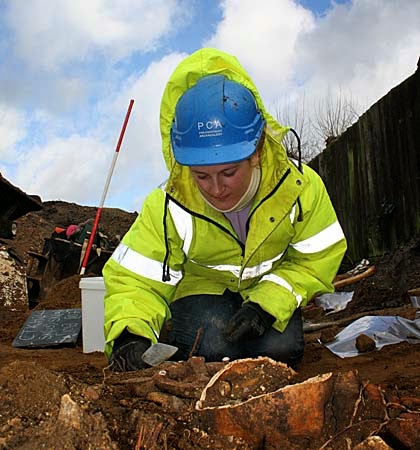
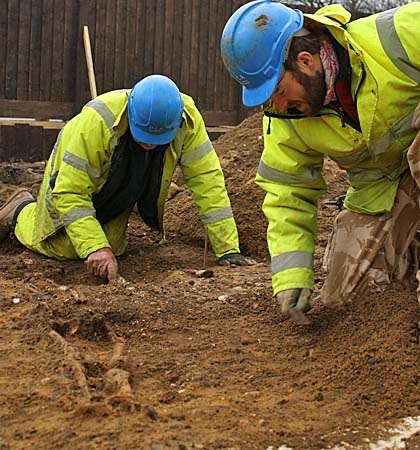
Shield-wearing skeleton, necklace and grave goods found in early Saxon inhumations.

The discovery of nine bodies in Cambridgeshire could reveal much about the little-known early Saxon period

An early Saxon man who fell on his shield has been found buried with a knife and spear alongside a jewellery-clad woman during a dig on a residential site in a Cambridgeshire village.

Grave goods, weaponry and everyday items from the 6th century surfaced during the excavation in Haddenham, where similar remains – including a double burial of a man and a woman – were first identified more than 20 years ago.

“A total of nine inhumations were discovered, ranging from the very young to fully grown adults,” says Jon House, of Pre-Construct Archaeology, thanking local residents for their “great interest” and “warm and welcoming” approach to the team during unfavourable weather conditions.

“The burials included an adult male, found lying upon a decorative shield and with a knife and a spear.

“A beaded necklace was found around the neck and upper torso of an adult female, who was also buried with a belt or girdle with copper and iron fittings.

“Projects such as these prove how even the smallest developments can yield a wealth of archaeological information and, in the case of this particular site, details not only of how people lived but also of their treatment towards the dead over 1,400 years ago.

“This is especially important during those periods, such as the early Saxon era, which have left little or no historical data.”


Source: Culture 24

Sunday, February 23, 2014

Is treasure hoard found in Germany linked to Nibelung legend?

An amateur treasure hunter equipped with a metal detector has discovered a hoard of gold and silver dating back to late Roman times in a German forest.  The finding has prompted speculation that it could be the legendary Nibelung treasure. The unnamed treasure seeker came across the buried treasure, estimated to be worth more than €1 million, while searching a wooded area in southern Rhineland-Palatinate with a metal detector.  The trove includes numerous leaf-shaped solid gold brooches, which are thought to have formed part of the decorations from a coat of a Roman ruler, as well as a solid silver bowl set with gold and stones set within it, and a set of gold and silver plated statuettes which formed part of a military commander’s portable chair. 
Experts say the treasure, some of which appears Eastern European in style, was buried around 1,500 years ago, about the time when Germanic Teutons were plundering and pillaging their way through the crumbling Roman Empire. “In terms of timing and geography, the find fits in with the epoch of the Nibelung legend,” said Axel von Berg, the state’s chief archaeologist. “But we cannot say whether it actually belongs to the Nibelung treasure,” he said, adding that whoever owned it had “lived well” and could have been a prince. The Nibelungs is the most famous Epic in Norse mythology and is said to be based on the Royal family of Burgundy. The story begins when a treasure of the Burgundians falls into the hands of Siegfried. After helping King Gunther woo Brunhild, Siegfried marries Kriemhild, Gunther's sister. Ultimately, a row between the Queens leads to the death of both Siegfried and Kriemhild, and the loss of the treasure. Whether the treasure is the famous “Rhinegold” or not, it seems to have been buried in haste by its owner or by robbers in around 406-407 AD, when the Roman Empire was falling apart in the area along the Rhine. Prosecutors have begun an inquiry into the hobbyist who discovered the treasure because they suspect he may have sold some of it, possibly to a buyer abroad. 


Source: Ancient Origins

(VIDEO) 10 Words in Mysterious Voynich Manuscript Decoded.

A researcher claims he's decoded 10 possible words in the famously unreadable Voynich manuscript, which has eluded interpretation for a century.
The book's 250 vellum pages are filled with writings in an unknown alphabet and elaborate drawings depicting a range of subjects from female nudes to medicinal herbs to Zodiac symbols. The medieval text was discovered by an antique book dealer in 1912, and it has been rather stingy in giving up its secrets ever since.
Now Stephen Bax, a professor of applied linguistics at the University of Bedfordshire in England, says he's deciphered 14 characters of the script and can read a handful of items in the Voynich text, such as the words for coriander, hellebore and juniper next to drawings of the plants. He says he's also picked out the word for Taurus written beside an illustration of the Pleiades, a star cluster in the constellation Taurus. [Voynich Manuscript: Images of the Unreadable Medieval Book]
"I hit on the idea of identifying proper names in the text, following historic approaches which successfully deciphered Egyptianhieroglyphs and other mystery scripts, and I then used those names to work out part of the script," Bax said in a statement.
"The manuscript has a lot of illustrations of stars and plants," Bax added. "I was able to identify some of these, with their names, by looking at mediaeval herbal manuscripts in Arabic and other languages, and I then made a start on a decoding, with some exciting results."
The Voynich manuscipt now sits in a rare books library at Yale University. Carbon dating proved that it dates back to the 15th century, and researchers believe it was written in Central Europe. While some scholars have written it off as a Renaissance-era hoax full of nonsense text, others say the pattern of the letters and words suggest the book was written in a real language or at least an invented cipher. A recent statistical study published in the journal PLOS ONE found that "Voynichese" adheres to linguistic rules.
Bax notes that the manuscript is still a long way from being understood, and that he is coming forward with what he's found thus far in the hopes that other linguists will work with him to crack the code. For now, he thinks the book is "probably a treatise on nature, perhaps in a Near Eastern or Asian language."
Bax has explained his ideas in a manuscript and in a YouTube video on his website.


Source: Live Science

Monster Surf Exposes Rare Petroglyphs in Hawaii.

Epic winter swells just off of Oahu, Hawaii, have churned up monster waves more than 7 meters high, sent seawater surging around the foundations of beachfront homes, and gnawed away at sandy cliffs along the island’s North Shore.
They’ve also exposed rare petroglyphs that have not been seen in years.
The unusually strong seasonal surf has washed away layers of sand all along Pupukea Beach, just east of the big-surf mecca of Waimea, to reveal dozens of large glyphs carved into the bench of lava rock.
More than 70 carvings have been exposed, mostly depicting human-like figures and dogs, according to the Historic Hawaii Foundation, whose workers are documenting the images.
A public safety officer reported the find to the foundation in late January, but social media have been rife with reports by surfers, beachcombers, and rock-art enthusiasts who have been sharing pictures of the glyphs since shortly after the new year when the swell started.
By most accounts, the North Shore petroglyphs were last seen in 2010, when similar winter weather exposed some of them. Before that, they had not been observed since 2004.
The appearance of the markings seems to coincide with El NiƱo, the periodic climate anomaly that causes unusually warm waters in the equatorial Pacific, and huge surf off of Oahu.
A weaker version of this cycle occurred in 2004, while 2010′s was particularly strong, as this year’s is shaping up to be.
Because they’re seen so rarely, the petroglyphs do not seem to have been the subject of very thorough study; they were reportedly first documented by archaeologists in 1970, and new ones have been identified as recently as 1983.
But previous research into Hawaiian petroglyphs, known locally as kii pohaku, has suggested that such carvings were used to document travels around and among the islands, to commemorate important events, and to mark trails and boundaries.
At Pu’u Loa, a vast field of more than 23,000 petroglyphs on Hawaii’s Big Island, many of the motifs are notable for featuring holes in which Native Hawaiians deposited the umbilical cords of newborn babies.
Back on O’ahu, depictions of dogs are particularly prevalent.
In addition to those newly exposed on the North Shore, canines appear often at the Nu’uanu rock art site near Honolulu, where they have been said to depict a wicked, cannibalistic dog-like beast known as Kaupe.

Source: Western Diggs

Saturday, February 22, 2014

The Apollo of Gaza: One fisherman's amazing catch

A statue thought to be an ancient bronze of Apollo, Greek God of poetry and love, has dropped off the radar after being found in the sea off Gaza last summer and surfacing briefly on eBay. It is 2,500 years old and priceless.
Jawdat Abu Ghurab used to be a builder but in 2007 Israel restricted the delivery of building materials to the Gaza strip, so he became a fisherman like his father.
He only has a small boat so never goes out far, and catches only small fish. One day last August, though, the 29-year-old from Deir al-Balah ended up with a very different haul.
His uncle was also fishing that day, but gave up early. Ghurab kept going.
"I stayed alone in the sea with a small boat and paddle, I waited for hours and did not imagine what fate had in store for me in the depths of the sea," he says.
"Sometimes waves move the bottom of the sea, small fish go to that spot in search of food, I saw the fish congregate in an area not far from the coast, only 100m out, so I rowed out there and, immersed in the sea, I saw the body of a person, half-buried under the sand."
At first Ghurab was scared. He stared into the water but did not recognise the man's face. When he dived in and touched the body it felt like stone.
"I tried to move it, to make sure that it was a statue, but it was too heavy," he says. "The colour was golden so it was easy to think it was gold."
Ghurab marked the spot and went back to the beach to fetch his relatives. They returned and dived down together - it was at a depth of about four metres, Ghurab estimates.
"We were able to slide it under the water for a metre or two metres and then go up again to take a breath and try again," he says.
After four hours they succeeded in getting the object out of the water. It was the statue of a naked man. They loaded it on to a cart and took it to Ghurab's house.
"My wife covered her face when she saw him lying naked in the house. She begged me to cover it," he says, laughing.
Ghurab's uncle, Atef, proposed cutting the statue into small pieces and selling it.
"After I saw the yellow colour at the head of the statue I thought it was made of gold, but one of my sons
suggested cutting off the finger and taking it to the market to check.We remembered that one of our relatives worked in the neighbourhood selling gold. We called him and he examined the statue and told us that it was made of bronze."
But he also said the bronze statue could be even more precious than if it had been made of gold.
Ghurab considered trying to smuggle the statue into Egypt to sell it, but the smugglers' tunnels - dug to circumvent restrictions put in place by Israel and Egypt after the Islamist movement Hamas came to power in Gaza - have been out of action since they were closed by the Egyptian army last summer.
Neighbours started asking questions, so Ghurab asked a relative - a commander in Hamas's military wing, the Izz al-Din al-Qassam Brigades - to help him hide it.
"The people who took the statue said they would send me a handsome reward after they sell it, but we have not got anything yet," he says.
For a while it was for sale on eBay, with an asking price of $500,000. Then the listing disappeared.
Ahmed Elburch, an official at the Hamas-run Ministry of Tourism and Antiquities in Gaza, says he last saw the statue in October. He was concerned about its condition, he says, as the colour appeared to be changing, and one of the eyes had been cut out.
He says a request from the Louvre to borrow the 500kg, 1.75m statue is currently being studied.
Hamas police refused my request to see it.
People living in the north of the Gaza Strip say it is still being held by militants, who have refused to hand it over to the Hamas government.
But no-one can be sure.
Listen to Shahdi Alkashif's report on the missing statue on The Fifth Floor, on the BBC World Service, or download the podcast.

'Vitruvian Man' May Have Had A Hernia, Surgeon Says

Leonardo da Vinci made it his mission to sketch the male body with ideal human proportions in the late 1400s. But it turns out, his "Vitruvian Man" may not be so perfect after all.
Dr. Hutan Ashrafian, a surgeon at the Imperial College London in the U.K., noticed something rather odd when he got up close and personal with the iconic drawing.
Story continues below.
"Vitruvian Man," a drawing by Leonardo da Vinci circa 1490.
"I noticed that Leonardo da Vinci's image of a man had a feature that may have been pathological. Notably a lump in the left groin region," Ashrafian told The Huffington Post in an email. "For an adult male that Leonardo was depicting, a lump in the groin of this nature is most likely diagnosed as a hernia."
Ouch. An inguinal hernia occurs when soft tissue from the abdomen or intestine pushes through a weak spot in the lower abdominal muscles. It appears as a bulge on one or both sides of the groin or scrotum. These hernias occur in more than a quarter of men and 2 percent of women.
Ashrafian said in the email that Da Vinci may have modeled the "Vitruvian Man" after a cadaver who died from complications from a hernia.
"The image therefore represents Leonardo's true genius of objectively depicting exactly what he observed rather than interpreting art through stylisms," Ashrafian told HuffPost in the email. "The only way to verify the hernia is to see if there were any other images of the same individual or if the actual body was somehow preserved. Both of these are realistically unlikely."
What do other experts think of this diagnosis?
"If it isn’t a hernia, then I really have no idea what it would be," Dr. Michael Rosen, director of the Comprehensive Hernia Center at University Hospitals Case Medical Center, told Slate.
This isn't the first time Ashrafian has doled out post-mortem diagnoses to iconic historical figures. For instance, in 2012, he suggested that King Tut may have died from epilepsy.

Source:  HUFFPOST

A lost city reveals the grandeur of medieval African civilization

Some of the world's greatest cities during the Middle Ages were on the eastern coast of Africa. Their ornate stone domes and soaring walls, made with ocean corals and painted a brilliant white, were wonders to the traders that visited them from Asia, the Middle East, and Europe. They were the superpowers of the Swahili Coast, and they've long been misunderstood by archaeologists. It's only recently that researchers outside Africa are beginning to appreciate their importance.
Throughout the Middle Ages, great civilizations ringed the Indian Ocean. From Egypt, people could travel the Red Sea to reach the ocean, then sail south to Africa, or continue east to the Arab world and India. Then, of course, one could travel over land on the famous Silk Road from India through central Asia and into China. In reality, few people ever made that journey. But many trade goods did, passed from hand to hand in cosmopolitan cities whose cultural diversity would have made places like New York and Sao Paolo look like monocultures. Among those great medieval cities were places like Songo Mnara, a gorgeous and bustling Swahili city built on an island off the coast of Tanzania in the fourteenth century.
At a time when European cities were getting wiped out by plagues and famines, Songo Mnara was thriving.
This month, Samir Patel has a fascinating article in Archaeology about the city. He writes:
From the tenth to fifteenth centuries, the riches of Africa's interior, such as ivory, gold, resins, food, timber, and even slaves, were in high demand around the world. Because of the monsoon trade winds, which could reliably bring traders from around the Indian Ocean to and from the East African coast, many of these goods passed through Swahili towns and into a hemisphere-spanning trade network—through the Red and Mediterranean Seas to Europe, across the ocean to India and Persia, and to China via sea and land. Some of the Swahili stone towns—a collective description of some settlements with stone ruins across miles of coast—grew spectacularly wealthy on this trade. They were independently ruled sultanates that shared intracoastal trade, culture, language (Kiswahili), religion (Islam), and receptiveness to the influence of the outside world. Like the independent city-states of the same period in Italian history, some were major powers, and their fortunes rose and fell with shifting trade relationships and political maneuvering.
Today, Songo Mnara is a ruin that had been almost forgotten by people living outside the local area. It was built by the people of Kilwa Kisiwanti, an ancient city on a nearby island, and they did it the way today's best city planners might. Though no one is sure why, they wanted to erect this city quickly. So they drew up a city plan and organized the homes, palace, and town's mosques around graceful open areas, with generously-sized courtyards that the locals used to greet traveling merchants.
Swahili towns didn't have marketplaces like comparable cities in Europe, the Middle East and China. Instead, archaeologists are learning, trade was conducted in the courtyards, which were halfway between public and private space. Similar kinds of public/private areas were common in ancient Rome as well. Perhaps merchants would stay with a family and other city dwellers would visit to trade with them. Or perhaps they would travel from courtyard to courtyard, offering their wares.
The people who lived in Songo Mnara were part of a Sultanate, or city-state, connected to their parent city of Kilwa. They spoke Kiswahili (related to today's Swahili), and were part of an enormous cultural network that spanned the coast from Somalia to Tanzania. Like the Arab peoples they traded with, the people of the Swahili Coast were Muslims and some of their most breathtaking architecture can be seen in the towers that crown their mosques.
Below, you can see the octagonal pool that once was a gorgeous water feature in the Sultan's palace on Kilwa.
According to one of the archaeologists who is now excavating Songo Mnara, University of York archaeologist Stephanie Wynne-Jones, it's very possible that Islamic practices in medieval Songo Mnara were different from the ones popular in the same region today.
Writes Patel:
According to ethnographic research, Swahili society is traditionally matrilocal (meaning that a man, after marriage, moves in with his wife's family), which doesn't seem to jibe with the more socially conservative form of Islam practiced on the Swahili Coast today. It is thought that the later Omani occupation of the region imposed a stricter version of Islam with regard to women, overwriting what could have been a brand of Swahili Islam with greater gender equality.
One of the key pieces of evidence for this earlier form of Islam can be found on Songo Mnara, where University of Bristol archaeologist Mark Horton believes he's uncovered a mosque that was purpose-built for women. Horton is an expert on mosque architecture and believes that such a mosque would be unique in the Islamic world and would have reflected the importance of women in Swahili society of the middle ages. It's possible that women prayed alongside the men in the many other mosques of the town, and eventually were segregated into their own mosque as their roles changed over time. We don't know for sure, and Horton says that it's always possible that the building was for some other purpose — perhaps a Koranic school — they still haven't figured out yet.
Below, the ruin of the possible women's mosque. Below that, we can see an excavation area where houses once were.
For Horton and Wynne-Jones, excavating Songo Mnara is a rare privilege — it's a mostly-undisturbed site, largely ignored by scientists and locals alike. Partly, it's been preserved so well because archaeologists from an earlier era didn't believe it was a legitimate African ruin — they believed the architecture was too sophisticated, and therefore had to have been crafted by Arab traders who wanted an outpost. That idea has long been disproven, and now the archaeological community accepts that the vibrant Swahili culture was purely African in origin, and that the cultural influences from the Middle East cut both ways. The Swahili Coast and its luxurious arts and goods were an enormous influence on their neighbors ringing the Indian Ocean.
But the power of the Swahili Coast fell as European powers rose. Patel explains:
At the end of the fifteenth century, the Portuguese arrived and Indian Ocean trade changed. Many stone towns were abandoned around this time, often hastily. Through the ensuing 500 years of colonial occupation—Portuguese, Omani, British—the Swahili culture that coalesced in the medieval period has persisted. Today, more than a million people in East Africa still identify as Swahili (fromSawahil, an Arabic word meaning "people of the coast").
Below is a drawing of Kilwa from a European map drawn in the sixteenth century, roughly a century after the city's heyday as a trade power. Admiration for the city's beauty had spread far and wide.
And, as the survival of Swahili culture in Africa attests, the memory of the great trade empire lives on in the peoples of the region. Now, as archaeologists learn more about this history, it's becoming more obvious than ever how crucial African civilizations were to the development of the medieval world.
Read more in Archaeology